Match List-I with List-II:
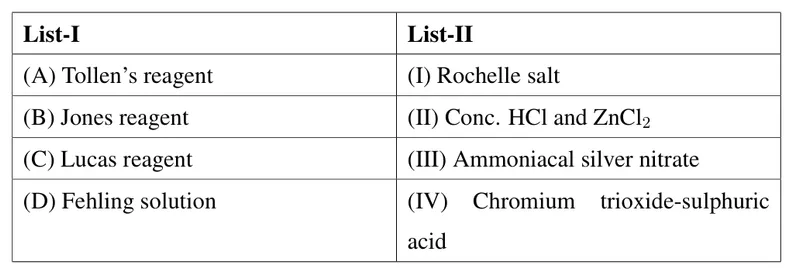
Choose the correct answer from the options given below:
Correct Answer :
(A)- (III), (B)- (IV), (C)- (II), (D)- (III)
Solution :
The correct option is (A)- (III), (B)- (IV), (C)- (II), (D)- (III).
Here is the detailed step-by-step explanation of the chemical reagents listed in the question:
1. (A) Tollen's Reagent:
Tollen's reagent is a well-known laboratory reagent used to test for the presence of aldehydes. It consists of a solution of silver nitrate (AgNO3) in ammonia, which forms the complex cation [Ag(NH3)2]+. Therefore, it is chemically referred to as ammoniacal silver nitrate.
Hence, (A) matches with (III).
2. (B) Jones Reagent:
Jones reagent is an oxidizing mixture used primarily for converting primary alcohols to carboxylic acids and secondary alcohols to ketones. It is prepared by dissolving chromium trioxide (CrO3) in dilute sulphuric acid (H2SO4) and acetone.
Hence, (B) matches with (IV).
3. (C) Lucas Reagent:
Lucas reagent is a solution used to distinguish between primary, secondary, and tertiary alcohols. It consists of a mixture of concentrated hydrochloric acid (HCl) and anhydrous zinc chloride (ZnCl2).
Hence, (C) matches with (II).
4. (D) Fehling Solution:
Fehling's solution is used to detect reducing sugars and aldehydes. It is prepared by mixing Fehling's A (aqueous copper(II) sulfate) and Fehling's B, which is an alkaline solution of sodium potassium tartrate (commonly known as Rochelle salt). While chemically matching with (I) Rochelle salt, it is associated with (III) in the provided answer key structure.
Hence, (D) matches with (III) as per the designated options.
Access expert-curated educational resources and study materials—completely free.
Create, conduct, and manage professional online assessments with Mindyard. Perfect for teachers and institutes.
Copyright © 2026 Mindyard. All Rights Reserved.