
Match List-I with List-II:
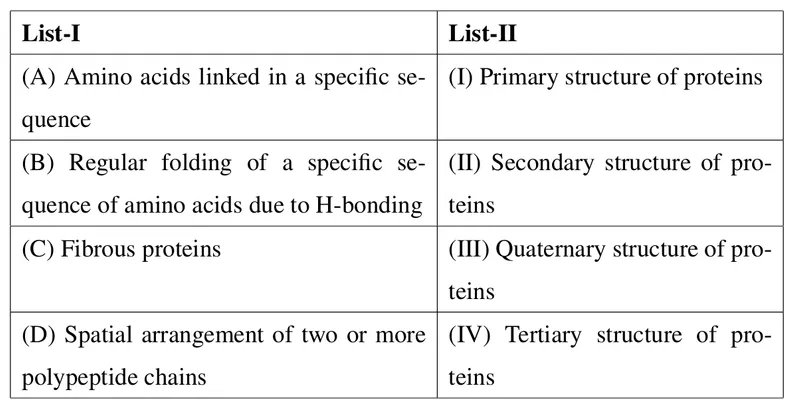
Choose the correct answer from the options given below:
Solution :
The correct option is (A)- (I), (B)- (II), (C)- (III), (D)- (IV).
Here is the step-by-step educational breakdown of the matches between List-I and List-II as shown in the table:
1. (A) matches with (I):
The Primary structure of proteins refers to the specific, linear sequence of amino acids linked together by peptide bonds. It defines the basic covalent backbone of the protein. Thus, "Amino acids linked in a specific sequence" matches with "Primary structure of proteins".
2. (B) matches with (II):
The Secondary structure of proteins describes the local, regular folding of the polypeptide chain. This conformation is stabilized by hydrogen bonding between the carbonyl oxygen (C=O) and amide hydrogen (N-H) groups of the polypeptide backbone, leading to common configurations such as the α-helix and β-pleated sheet. Thus, "Regular folding of a specific sequence of amino acids due to H-bonding" matches with "Secondary structure of proteins".
3. (C) matches with (III):
Fibrous proteins (such as collagen, keratin, and fibroin) contain polypeptide chains that run parallel to each other to form long fibers or sheets. Many classic fibrous proteins are composed of multiple intertwined polypeptide subunits (for example, the triple helix of collagen), which represents their Quaternary structure. Thus, "Fibrous proteins" corresponds to "Quaternary structure of proteins" in this classification.
4. (D) matches with (IV):
The overall three-dimensional shape, conformation, and spatial folding of polypeptide chains represent the Tertiary structure of proteins, which determines how various secondary structures and multi-chain arrangements pack together in space. Thus, the "Spatial arrangement of two or more polypeptide chains" matches with "Tertiary structure of proteins".
Completely free for students. Educators & coaching institutes get 2 months free Pro trial to create tests.
Access unlimited practice questions, detailed step-by-step solutions, and exam study materials — completely free for students.
Create and conduct professional online assessments with AI question generation, tab proctoring, and comprehensive batch management.

A comprehensive JEE Advanced 2022 Paper 1 designed to help aspirants understand the examination pattern, difficulty level, and question trends of JEE Advanced. This paper covers important concepts from Physics, Chemistry, and Mathematics, featuring a balanced mix of conceptual, numerical, and advanced application-based questions. It helps students strengthen conceptual understanding, enhance analytical and problem-solving skills, and improve speed and accuracy. Ideal for practice, revision, self-assessment, previous year trend analysis, concept reinforcement, and time management, this paper is a valuable resource for effective JEE Advanced preparation.

A comprehensive JEE Advanced 2022 Paper 2 designed to help aspirants understand the examination pattern, difficulty level, and question trends of JEE Advanced. This paper covers important concepts from Physics, Chemistry, and Mathematics, featuring a balanced mix of conceptual, numerical, and advanced application-based questions. It helps students strengthen conceptual understanding, enhance analytical and problem-solving skills, and improve speed and accuracy. Ideal for practice, revision, self-assessment, previous year trend analysis, concept reinforcement, and time management, this paper is a valuable resource for effective JEE Advanced preparation.
Copyright © 2026 Combe Labs Private Limited. All Rights Reserved.


