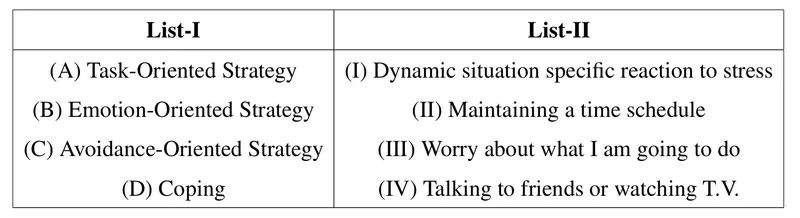
Match List-I with List-II
Choose the correct answer from the options given below:
Correct Answer :
(A)- (II), (B)- (IV), (C)- (III), (D)- (I)
Solution :
The correct option is (A)- (II), (B)- (IV), (C)- (III), (D)- (I).
Here is the step-by-step explanation of the matching between List-I and List-II based on psychological concepts of stress and coping:
1. (A) Task-Oriented Strategy matches (II) Maintaining a time schedule:
Task-oriented coping strategies involve taking direct action to solve, modify, or minimize the impact of the stressful situation. They are problem-focused behaviors. "Maintaining a time schedule" is a direct, organized, and proactive action taken to manage tasks and resolve time-related stressors.
2. (B) Emotion-Oriented Strategy matches (IV) Talking to friends or watching T.V.:
Emotion-oriented coping strategies aim to regulate the emotional distress associated with a stressful situation rather than solving the problem itself. Seeking social support by talking to friends or finding distraction/comfort by watching T.V. are activities directed at managing and altering one's emotional state to reduce immediate stress.
3. (C) Avoidance-Oriented Strategy matches (III) Worry about what I am going to do:
Avoidance-oriented coping involves cognitive or behavioral attempts to deny, minimize, or physically/mentally distance oneself from directly confronting a stressor. Preoccupying oneself with passive "worry about what I am going to do" rather than taking active steps to solve the issue represents a cognitive form of avoidance and hesitation.
4. (D) Coping matches (I) Dynamic situation specific reaction to stress:
In psychology (such as in Lazarus and Folkman's cognitive-mediational theory), coping is defined as a dynamic, situation-specific reaction to stress. It is not a static trait but rather a set of constantly changing cognitive and behavioral efforts used to manage specific external and/or internal demands that are appraised as taxing or exceeding the resources of the person.
Access expert-curated educational resources and study materials—completely free.
Create, conduct, and manage professional online assessments with Mindyard. Perfect for teachers and institutes.
Copyright © 2026 Mindyard. All Rights Reserved.