Match the compounds in List-I with the appropriate observations in List-II and choose the correct option.
Correct Answer :
P → 2; Q → 5; R → 1; S → 3
Solution :
Correct Answer: P → 2; Q → 5; R → 1; S → 3
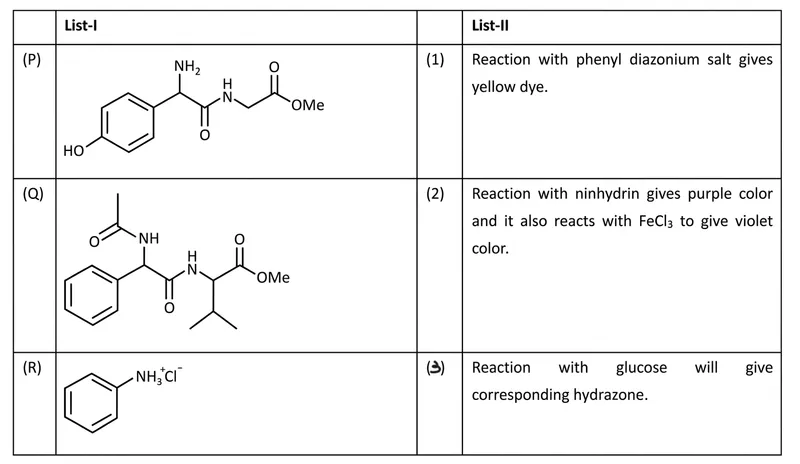
Let us analyze the chemical properties and qualitative tests for each compound given in List-I to match them with the appropriate observations in List-II:
1. Analysis of Compound (P):
Compound (P) contains a free primary aliphatic amino group (-NH2) and a phenolic hydroxyl group (-OH) attached to a benzene ring (a tyrosine derivative component).
- Due to the presence of the free primary amino group (-NH2), it reacts positively with ninhydrin to produce a purple color (Ruhemann's purple).
- Due to the presence of the phenolic -OH group, it reacts with neutral FeCl3 to give a characteristic violet color complex.
Therefore, P matches with (2).
2. Analysis of Compound (Q):
Compound (Q) has an acetylated amino group at the N-terminus, so it lacks a free primary amino group and initially gives a negative ninhydrin test.
- Upon complete hydrolysis of the peptide and ester bonds, free amino acids with free primary amino groups are released, which then give a positive ninhydrin test.
- Since it contains a phenyl ring without a phenolic -OH group (unlike tyrosine), it does not give a positive phthalein dye test.
Therefore, Q matches with (5).
3. Analysis of Compound (R):
Compound (R) is anilinium chloride (C6H5NH3+Cl-), which dissociates in solution to provide free aniline (C6H5NH2).
- Aniline acts as a nucleophile when treated with a phenyl diazonium salt (coupling reaction) under weakly acidic/neutral conditions to form an azobenzene derivative, producing a characteristic yellow dye.
Therefore, R matches with (1).
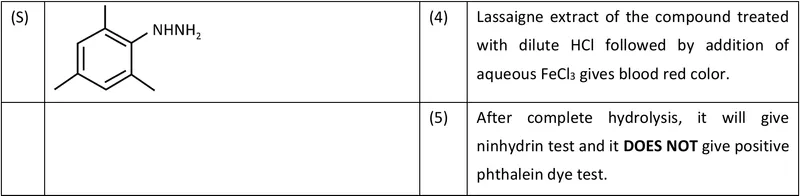
4. Analysis of Compound (S):
Compound (S) is 2,4,6-trimethylphenylhydrazine (a derivative of phenylhydrazine containing a free -NHNH2 group).
- Substituted hydrazines react with carbonyl compounds such as glucose to form the corresponding hydrazone (or osazone).
Therefore, S matches with (3).
Conclusion:
The correct matching sequence is: P → 2; Q → 5; R → 1; S → 3.
Access expert-curated educational resources and study materials—completely free.
Create, conduct, and manage professional online assessments with Mindyard. Perfect for teachers and institutes.
Copyright © 2026 Mindyard. All Rights Reserved.