
Read the data carefully and answer the questions.
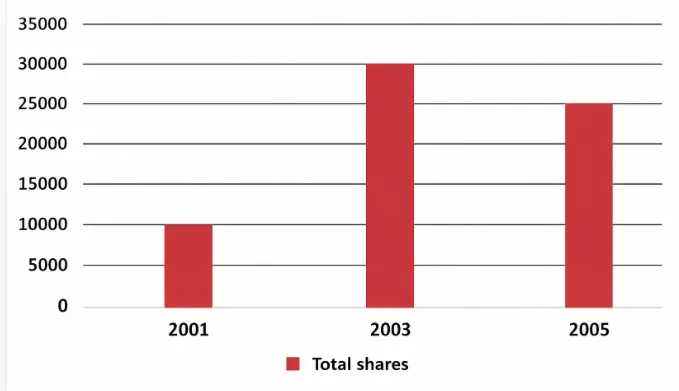
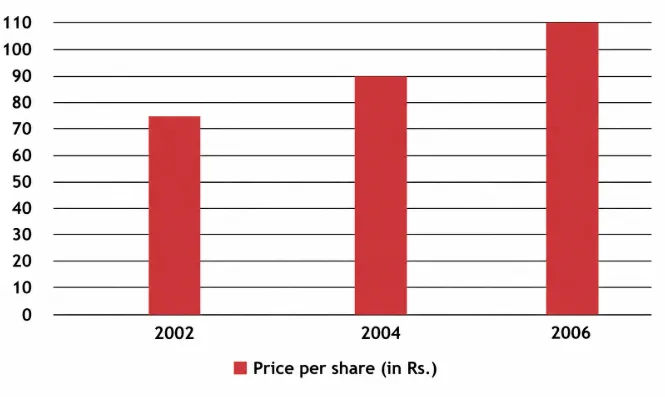
Note: (i) Market value = Total number of shares × price of one share
(ii) Number of shares increased by 20% from 2001 to 2002 and price of share decreased by 5% from 2002 to 2003.
(iii) Price of share decreased by 12% from 2005 to 2006 and number of shares decreased by 10% 2005 to 2006.
In 2002, 70% of total market value received from old shareholders and rest received from new shareholders. Find the total market value received from new shareholders.
Correct Answer :
270,000
Solution :
The correct answer is 270,000.
Let's break down the solution step-by-step based on the provided graphs and notes:
Step 1: Find the total number of shares in the year 2001.
From the first bar graph ("Total shares"), the total number of shares in 2001 is 10,000.
Step 2: Calculate the total number of shares in the year 2002.
According to Note (ii), the number of shares increased by 20% from 2001 to 2002.
Therefore, we calculate the number of shares in 2002 as follows:
Step 3: Find the price per share in the year 2002.
From the second bar graph ("Price per share in Rs."), the price of a share in 2002 is Rs. 75.
Step 4: Calculate the total market value in the year 2002.
According to Note (i), the Market value = Total number of shares × Price of one share:
Step 5: Find the market value received from new shareholders.
In 2002, 70% of the total market value was received from old shareholders. This means the remaining percentage received from new shareholders is:
Now, we calculate 30% of the total market value of Rs. 900,000:
Thus, the total market value received from new shareholders is 270,000.
Access expert-curated educational resources and study materials—completely free.
Create, conduct, and manage professional online assessments with Mindyard. Perfect for teachers and institutes.
Copyright © 2026 Mindyard. All Rights Reserved.




