Correct Answer :
)/2
Solution :
The correct answer is:
1. Image Analysis and Given Information:
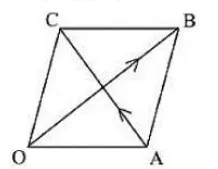
By analyzing the provided image, we can identify a parallelogram labeled counter-clockwise with vertices O (at the bottom-left), A (at the bottom-right), B (at the top-right), and C (at the top-left).
The diagonals of the parallelogram are shown with directional arrows indicating vector paths:
- The diagonal from O to B is labeled with an arrow pointing towards B, representing the vector:
- The diagonal from A to C is labeled with an arrow pointing towards C, representing the vector:
2. Defining the Vector Relations:
Let us define the sides of the parallelogram as vectors. Let O be the origin.
Let:
and
Since OABC is a parallelogram, the opposite sides are equal and parallel. Therefore:
and
3. Setting up the Vector Equations:
Using the triangle law of vector addition on triangle OAB:
Substituting the defined vectors:
(Equation 1)
Similarly, applying vector subtraction to express the diagonal vector in terms of the position vectors of C and A:
Substituting the defined vectors:
(Equation 2)
4. Solving for Vector OA:
We want to find vector , which is defined as .
To isolate , we subtract Equation 2 from Equation 1:
Simplifying the right-hand side:
Dividing both sides by 2:
Thus, the vector is equal to:
Access expert-curated educational resources and study materials—completely free.
Create, conduct, and manage professional online assessments with Mindyard. Perfect for teachers and institutes.
Copyright © 2026 Mindyard. All Rights Reserved.