Positive Fehling solution test is given by
Correct Answer :
Solution :
The correct answer is 3.
Fehling's Solution Test Concept:
Fehling's test is a chemical test used to distinguish between aliphatic aldehydes and aromatic aldehydes or ketones.
1. Aliphatic aldehydes (such as CH3CHO, HCHO, cyclohexanecarbaldehyde) reduce copper(II) ions in Fehling's solution to give a red precipitate of cuprous oxide (Cu2O). Thus, they give a positive Fehling's test.
2. Aromatic aldehydes (such as benzaldehyde or p-nitrobenzaldehyde) do not give a positive Fehling's test because the aldehyde group (-CHO) is attached directly to an aromatic benzene ring, making oxidation under these conditions difficult.
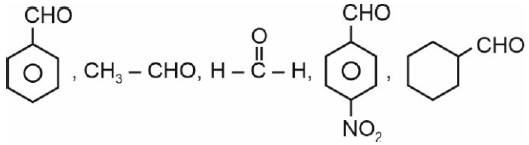
Analyzing the given compounds in the image:
Let's evaluate each of the 5 compounds shown from left to right:
1. Benzaldehyde (C6H5CHO): This is an aromatic aldehyde. Therefore, it gives a negative Fehling's test.
2. Acetaldehyde (CH3CHO): This is an aliphatic aldehyde. Therefore, it gives a positive Fehling's test.
3. Formaldehyde (HCHO / H-C(=O)-H): This is an aliphatic aldehyde. Therefore, it gives a positive Fehling's test.
4. p-Nitrobenzaldehyde (O2N-C6H4-CHO): This is an aromatic aldehyde. Therefore, it gives a negative Fehling's test.
5. Cyclohexanecarbaldehyde (C6H11CHO): This is an aliphatic (alicyclic) aldehyde since the -CHO group is attached to a non-aromatic cyclohexane ring. Therefore, it gives a positive Fehling's test.
Conclusion:
Out of the 5 given compounds, exactly 3 compounds (CH3CHO, HCHO, and cyclohexanecarbaldehyde) give a positive Fehling's solution test.
Access expert-curated educational resources and study materials—completely free.
Create, conduct, and manage professional online assessments with Mindyard. Perfect for teachers and institutes.
Copyright © 2026 Mindyard. All Rights Reserved.