
Select the graph that schematically represents BOTH y = x^m and y = x^1/m properly in the interval 0 ≤ x ≤ 1. For integer values of m, where m > 1
Options
Solution :
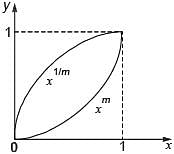
The correct option is represented by the first graph, where the curve labeled lies above the diagonal line and is concave down (slope decreases as increases), while the curve labeled lies below the diagonal line and is concave up (slope increases as increases).
To understand why this graph is correct, let us analyze the behavior of both functions, and , in the interval for an integer .
1. Value at Boundaries:
Both functions share the same values at the boundaries of the interval:
For :
and
For :
and
Thus, both curves start at the origin and end at the point .
2. Relative Magnitude of the Functions:
For any value of in the open interval , since the base is less than 1, raising it to a larger exponent results in a smaller value.
Since , we have:
This means that over the interval , the curve of must lie strictly above the curve of .
3. Curvature and Slope Analysis:
Let us evaluate the derivatives of both functions to determine their slopes and concavities.
For :
The first derivative (slope) is:
The second derivative (concavity) is:
Since and , both and . This means that is an increasing function with an increasing slope (concave up). At , the slope is 0.
For :
The first derivative (slope) is:
The second derivative (concavity) is:
Since , the term is negative, which makes the second derivative . This means that is an increasing function with a decreasing slope (concave down). At , the slope approaches infinity.
Conclusion:
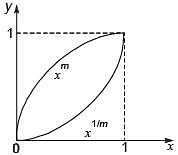
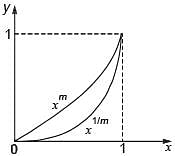
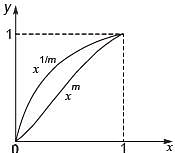
The curve of must be concave down and lie above the curve of , which must be concave up. Comparing the choices, the first option (Image 0) correctly displays as the upper concave-down curve and as the lower concave-up curve.
Completely free for students. Educators & coaching institutes get 2 months free Pro trial to create tests.
Access unlimited practice questions, detailed step-by-step solutions, and exam study materials — completely free for students.
Create and conduct professional online assessments with AI question generation, tab proctoring, and comprehensive batch management.

A comprehensive JEE Advanced 2022 Paper 1 designed to help aspirants understand the examination pattern, difficulty level, and question trends of JEE Advanced. This paper covers important concepts from Physics, Chemistry, and Mathematics, featuring a balanced mix of conceptual, numerical, and advanced application-based questions. It helps students strengthen conceptual understanding, enhance analytical and problem-solving skills, and improve speed and accuracy. Ideal for practice, revision, self-assessment, previous year trend analysis, concept reinforcement, and time management, this paper is a valuable resource for effective JEE Advanced preparation.

A comprehensive JEE Advanced 2022 Paper 2 designed to help aspirants understand the examination pattern, difficulty level, and question trends of JEE Advanced. This paper covers important concepts from Physics, Chemistry, and Mathematics, featuring a balanced mix of conceptual, numerical, and advanced application-based questions. It helps students strengthen conceptual understanding, enhance analytical and problem-solving skills, and improve speed and accuracy. Ideal for practice, revision, self-assessment, previous year trend analysis, concept reinforcement, and time management, this paper is a valuable resource for effective JEE Advanced preparation.
Copyright © 2026 Combe Labs Private Limited. All Rights Reserved.


