
Select the strongest Bronsted base.
Options


Solution :
To determine the strongest Brønsted base, we must evaluate the availability of the lone pair of electrons on the nitrogen atom in each of the given organic structures. A stronger Brønsted base is a more effective proton acceptor, meaning its nitrogen lone pair is more localized and readily available to bind to a hydrogen ion (H+).
Let's analyze the structures provided in the four images:
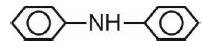
1. Diphenylamine (First Image):
The first image shows a central nitrogen atom (NH) bonded to two phenyl (benzene) rings. The lone pair of electrons on the nitrogen atom is delocalized via resonance into both aromatic rings. This extensive delocalization severely reduces the electron density on the nitrogen atom, making diphenylamine a very weak base.
2. Aniline (Second Image):
The second image shows aniline, where a nitrogen atom (NH2) is directly attached to a single benzene ring. The lone pair on the nitrogen is delocalized into the aromatic π-system of the benzene ring. While it is more basic than diphenylamine (since the lone pair is shared with only one ring instead of two), resonance delocalization still significantly reduces its basicity compared to aliphatic amines.
3. Pyrrole (Third Image):
The third image shows pyrrole, a five-membered heterocyclic ring with two double bonds and a nitrogen atom (N). In pyrrole, the lone pair of electrons on the nitrogen is part of the aromatic sextet containing
electrons. If the nitrogen atom accepts a proton, its lone pair is no longer available to participate in the ring, which breaks the aromatic stability of the molecule. Because losing aromaticity is highly unfavorable, pyrrole is an extremely weak base.
4. Pyrrolidine (Fourth Image):
The fourth image shows pyrrolidine, a saturated five-membered heterocyclic ring containing one nitrogen atom (N) with no double bonds. The nitrogen atom in pyrrolidine is
-hybridized, and its lone pair is fully localized on the nitrogen. Additionally, the surrounding alkyl carbon chains exert an electron-donating inductive effect (+I effect), which further increases the electron density on the nitrogen atom. This makes the lone pair highly available for protonation.
Therefore, pyrrolidine (shown in the fourth image) is the strongest Brønsted base among the given choices.
Completely free for students. Educators & coaching institutes get 2 months free Pro trial to create tests.
Access unlimited practice questions, detailed step-by-step solutions, and exam study materials — completely free for students.
Create and conduct professional online assessments with AI question generation, tab proctoring, and comprehensive batch management.

A comprehensive JEE Advanced 2022 Paper 1 designed to help aspirants understand the examination pattern, difficulty level, and question trends of JEE Advanced. This paper covers important concepts from Physics, Chemistry, and Mathematics, featuring a balanced mix of conceptual, numerical, and advanced application-based questions. It helps students strengthen conceptual understanding, enhance analytical and problem-solving skills, and improve speed and accuracy. Ideal for practice, revision, self-assessment, previous year trend analysis, concept reinforcement, and time management, this paper is a valuable resource for effective JEE Advanced preparation.

A comprehensive JEE Advanced 2022 Paper 2 designed to help aspirants understand the examination pattern, difficulty level, and question trends of JEE Advanced. This paper covers important concepts from Physics, Chemistry, and Mathematics, featuring a balanced mix of conceptual, numerical, and advanced application-based questions. It helps students strengthen conceptual understanding, enhance analytical and problem-solving skills, and improve speed and accuracy. Ideal for practice, revision, self-assessment, previous year trend analysis, concept reinforcement, and time management, this paper is a valuable resource for effective JEE Advanced preparation.
Copyright © 2026 Combe Labs Private Limited. All Rights Reserved.


