The average of three distinct real numbers is 28. If the smallest number is increased by 7 and the largest number is reduced by 10, the order of the numbers remains unchanged, and the new arithmetic mean becomes 2 more than the middle number, while the difference between the largest and the smallest numbers becomes 64. Then, the largest number in the original set of three numbers is:
Solution :
The correct answer is 70.
Let the three distinct real numbers in ascending order be represented as , , and , such that:
Here, is the smallest number, is the middle number, and is the largest number.
We are given that the average of these three numbers is 28. Therefore:
Multiplying both sides by 3, we get our first equation:
— (Equation 1)
Next, the smallest number is increased by 7, becoming .
The largest number is reduced by 10, becoming .
The middle number remains unchanged as .
Since the order of the numbers remains unchanged, the new smallest number is still the first term, the middle number is the second, and the new largest number is the third. Thus, the new set of numbers is:
Let us find the new arithmetic mean of these modified numbers:
New Mean =
Using Equation 1, we can substitute into this expression:
New Mean =
We are told that the new arithmetic mean is 2 more than the middle number . Therefore:
Solving for :
Now we substitute the value of back into Equation 1:
— (Equation 2)
We are also given that the difference between the new largest number and the new smallest number is 64. Therefore:
Simplifying the expression:
— (Equation 3)
Now, we have a system of two linear equations (Equation 2 and Equation 3) with two variables:
1)
2)
To find the largest number in the original set, we add the two equations together:
Thus, the largest number in the original set of three numbers is 70.
Completely free for students. Educators & coaching institutes get 2 months free Pro trial to create tests.
Access unlimited practice questions, detailed step-by-step solutions, and exam study materials — completely free for students.
Create and conduct professional online assessments with AI question generation, tab proctoring, and comprehensive batch management.
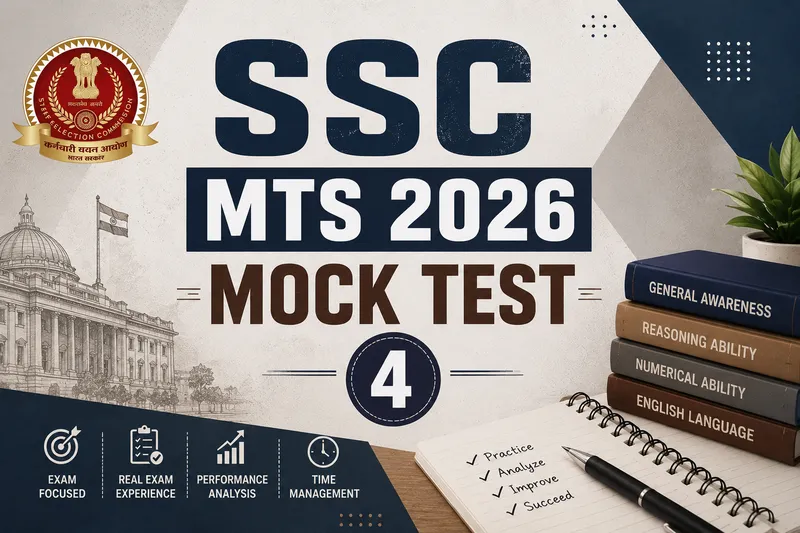
A comprehensive SSC MTS 2026 Mock Test 4 designed to help aspirants strengthen their preparation and improve their performance for the Staff Selection Commission Multi-Tasking Staff examination. This mock test covers all major sections including Numerical and Mathematical Ability, Reasoning Ability and Problem Solving, General Awareness, and English Language and Comprehension. It includes a balanced combination of conceptual, analytical, and exam-oriented multiple-choice questions aligned with the latest SSC MTS syllabus and exam pattern. Ideal for practice, revision, self-evaluation, accuracy improvement, speed enhancement, and effective time management, this mock test helps candidates assess their exam readiness, identify improvement areas, and build confidence for the SSC MTS 2026 examination
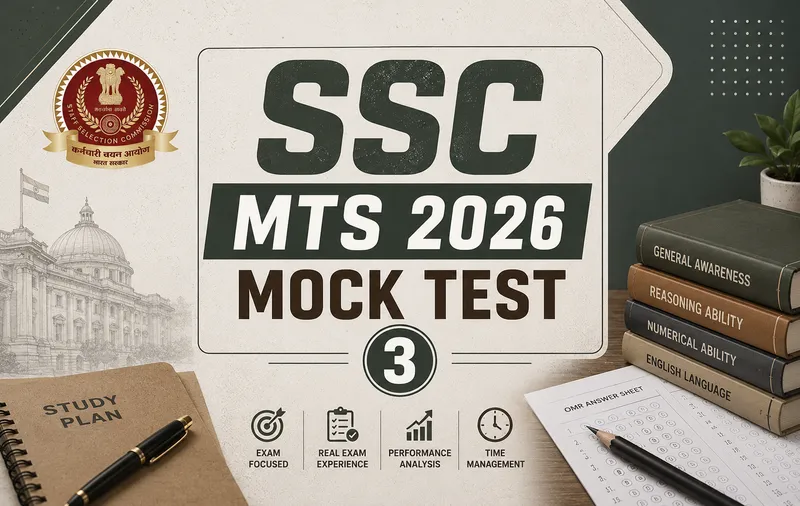
A comprehensive SSC MTS 2026 Mock Test 3 designed to help aspirants prepare thoroughly for the Staff Selection Commission Multi-Tasking Staff examination. This mock test covers all important sections including Numerical and Mathematical Ability, Reasoning Ability and Problem Solving, General Awareness, and English Language and Comprehension. It features a carefully curated set of multiple-choice questions that test conceptual understanding, logical reasoning, problem-solving skills, speed, and accuracy in accordance with the latest SSC MTS exam pattern. Ideal for practice, revision, self-assessment, performance evaluation, and time management improvement, this mock test enables candidates to identify strengths and weaknesses while building confidence for the SSC MTS 2026 examination.
Copyright © 2026 Combe Labs Private Limited. All Rights Reserved.