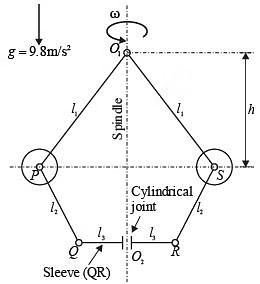
The figure shows a schematic of a simple Watt governor mechanism with the spindle O1O2 rotating at an angular velocity ω about a vertical axis. The balls at P and S have equal mass. Assume that there is no friction anywhere and all other components are massless and rigid. The vertical distance between the horizontal plane of rotation of the balls and the pivot O1 is denoted by h. The value of h = 400 mm at a certain ω. If ω is doubled, the value of h will be _________mm.
Solution :
The correct option is 100.
Analysis of the Governor Mechanism from the Diagram:
Based on the provided schematic diagram, we can observe the following components and parameters:
1. A vertical spindle axis O1O2 rotating at an angular velocity ω.
2. Two governor balls at P and S of equal mass (denoted as m).
3. The upper links O1P and O1S have length l1, connecting the pivot O1 to the balls.
4. The lower links PQ (length l2) and SR (length l2) connect the balls to the sleeve QR via horizontal connections of length l3 and a cylindrical joint at O2.
5. The acceleration due to gravity is directed vertically downward with g = 9.8 m/s2.
6. The vertical height h represents the distance from the pivot O1 to the horizontal plane of rotation of the balls P and S.
Mathematical Derivation:
Since all components other than the balls are massless and there is no friction, the tension in the links and the forces acting on a ball at equilibrium can be analyzed by taking moments about the pivot O1.
For a ball of mass m rotating at radius r, the forces acting on it are:
- The downward gravitational force:
- The outward horizontal centrifugal force:
Taking moments of these forces about the pivot O1:
Substitute the expressions for the forces:
By simplifying the equation (dividing both sides by m · r), we get:
Which gives the relation for the height of the Watt governor:
From this relation, we can see that the height h is inversely proportional to the square of the angular velocity ω:
Calculating the New Height:
Let h1 and ω1 be the initial height and angular velocity, and h2 and ω2 be the final height and angular velocity.
We are given:
- Initial height h1 = 400 mm
- The angular velocity is doubled: ω2 = 2ω1
Therefore, we can set up the ratio:
Substitute ω2 = 2ω1 into the ratio:
Now, solve for h2:
Substitute the value h1 = 400 mm:
Thus, the value of h when the angular velocity is doubled is 100 mm.
Completely free for students. Educators & coaching institutes get 2 months free Pro trial to create tests.
Access unlimited practice questions, detailed step-by-step solutions, and exam study materials — completely free for students.
Create and conduct professional online assessments with AI question generation, tab proctoring, and comprehensive batch management.

The GATE 2026 Mechanical Engineering (ME) examination scheduled for 14 February 2026 is one of the most important national-level competitive exams for engineering graduates aspiring for higher education and prestigious career opportunities in PSU and research organizations. Conducted annually at the national level, the GATE Mechanical Engineering paper evaluates candidates on core subjects such as Engineering Mechanics, Thermodynamics, Fluid Mechanics, Strength of Materials, Manufacturing Processes, and Machine Design, along with General Aptitude and Engineering Mathematics. This examination is a gateway for admission into M.Tech/Ph.D. programs at IITs, NITs, IISc, and other top institutions, as well as recruitment in major Public Sector Undertakings (PSUs) like ONGC, NTPC, BHEL, IOCL, and more. The GATE ME 2026 paper will test conceptual understanding, analytical thinking, and problem-solving ability, making strong preparation essential for success. Candidates are advised to practice previous year papers, mock tests, and focus on conceptual clarity for high scoring performance. This exam on 14/02/2026 is a crucial opportunity for mechanical engineering aspirants to secure their future in academia and industry.
Strengthen your preparation with this GATE 2025 Mechanical Engineering (ME) test, covering core subjects such as thermodynamics, fluid mechanics, strength of materials, theory of machines, and manufacturing engineering. With a well-balanced mix of conceptual and numerical questions, this test helps enhance problem-solving ability and technical understanding. Aligned with the latest exam pattern, it is ideal for improving accuracy, speed, and overall exam readiness.
Copyright © 2026 Combe Labs Private Limited. All Rights Reserved.