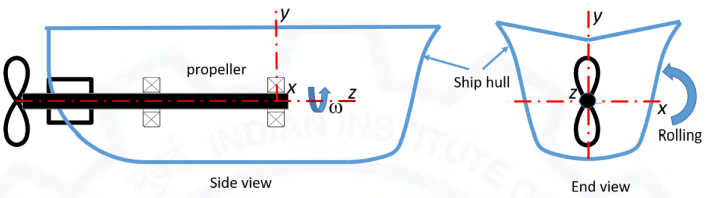
The figure shows an arrangement of a heavy propeller shaft in a ship. The combined polar mass moment of inertia of the propeller and the shaft is 100 kg.m2. The propeller rotates at ω = 12 rad/s. The waves acting on the ship hull induces a rolling motion as shown in the figure with an angular velocity of 5 rad/s. The gyroscopic moment generated on the shaft due to the motion described is ______ N.m. (round of to the nearest integer).
Correct Answer :
Correct answer is : 6000
l = 100 kgm2
ω = 12 rad/s
ωp = 5 rad/s
Gyroscopic couple 100 x 12 x 5 = 6000 Nm
Solution :
The correct answer is 6000.
Analysis of the Figure and Motion:
The provided image shows two views of the ship's propeller shaft assembly:
1. The Side view shows the propeller attached to a horizontal shaft aligned along the z-axis (axis of spin). The propeller and shaft rotate with an angular velocity about this axis.
2. The End view shows the "Ship hull" facing front-on, with the vertical y-axis and horizontal x-axis. It depicts a "Rolling" motion of the ship's hull about the longitudinal z-axis (the axis of the propeller shaft) represented by a curved arrow, with a rolling angular velocity .
Given Data:
- Combined polar mass moment of inertia of the propeller and shaft,
- Propeller spin velocity,
- Rolling angular velocity (precession velocity in this context),
Calculation of the Gyroscopic Moment:
The magnitude of the gyroscopic moment (or gyroscopic couple) generated on the shaft is given by the formula:
Substituting the given values into the formula:
Therefore, the gyroscopic moment generated on the shaft due to the described motion is 6000 N·m.
Access expert-curated educational resources and study materials—completely free.
Create, conduct, and manage professional online assessments with Mindyard. Perfect for teachers and institutes.
Copyright © 2026 Mindyard. All Rights Reserved.