The formal organisation can be better understood by a study of its features which are as follows:
(A) It specifies the relationships among various job positions and the nature of their interrelationship.
(B) It is a means to achieve the objectives specified in the plans, as it lays down rules and procedures essential for their achievement.
(C) Independent channels of communication without specified direction of flow of information are developed by group members.
(D) It is deliberately designed by the top management to facilitate the smooth functioning of the organisation.
Which of the following options are correct?
Solution :
The correct option is (A), (B) and (D) only.
To understand why this option is correct, let us analyze the features of a formal organisation step-by-step:
1. Understanding Formal Organisation:
A formal organisation refers to the structure of well-defined jobs, each bearing a definite measure of authority, responsibility, and accountability. It is consciously and deliberately designed by the management to achieve organizational goals.
2. Analysis of the Statements:
Statement (A): "It specifies the relationships among various job positions and the nature of their interrelationship."
This statement is correct. A fundamental feature of a formal organisation is that it clearly defines who reports to whom, establishing clear lines of authority and responsibility among different job roles.
Statement (B): "It is a means to achieve the objectives specified in the plans, as it lays down rules and procedures essential for their achievement."
This statement is correct. Formal structures are created to systematically direct efforts toward achieving planned objectives through established rules, policies, and standard operating procedures.
Statement (C): "Independent channels of communication without specified direction of flow of information are developed by group members."
This statement is incorrect. In a formal organisation, communication channels are predefined and follow a specific scalar chain or path. Independent and undirected communication channels are a characteristic of an informal organisation, which arises spontaneously out of social interactions among employees.
Statement (D): "It is deliberately designed by the top management to facilitate the smooth functioning of the organisation."
This statement is correct. Unlike informal structures that develop naturally, a formal organisation is deliberately planned and structured by top-level management to ensure systematic coordination and minimize confusion.
Conclusion:
Since statements (A), (B), and (D) are true features of a formal organisation, while statement (C) is a feature of an informal organisation, the correct combination is (A), (B) and (D) only.
Completely free for students. Educators & coaching institutes get 2 months free Pro trial to create tests.
Access unlimited practice questions, detailed step-by-step solutions, and exam study materials — completely free for students.
Create and conduct professional online assessments with AI question generation, tab proctoring, and comprehensive batch management.
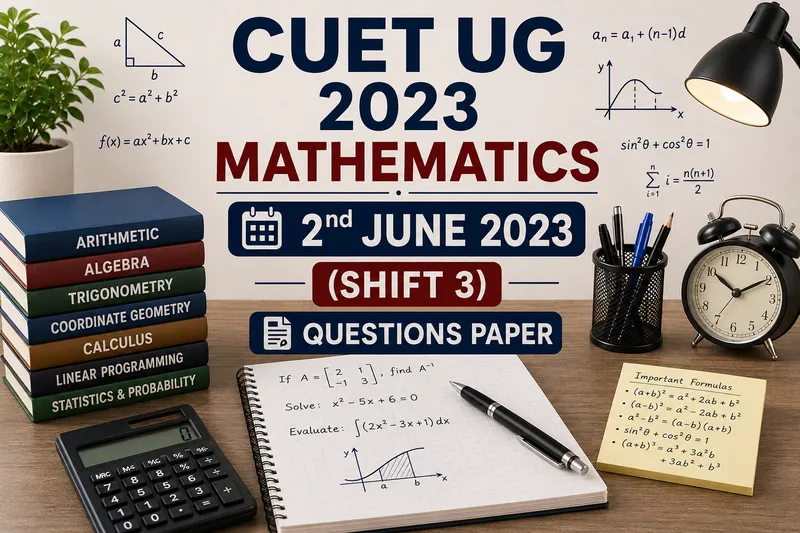
A comprehensive CUET UG Mathematics Question Paper with Solutions – 2 June 2023 (Shift 3) designed to help students practice and understand the actual CUET exam pattern. This paper covers important topics from Algebra, Calculus, Coordinate Geometry, Probability, Statistics, Matrices, Determinants, and Vectors, featuring a balanced mix of conceptual, numerical, and application-based questions. Detailed solutions are provided to strengthen problem-solving skills, improve conceptual clarity, and enhance calculation accuracy. Based on the CUET syllabus and previous year exam trends, this paper is ideal for practice, revision, self-assessment, time management, previous year analysis, and final preparation for upcoming CUET UG Mathematics examinations.
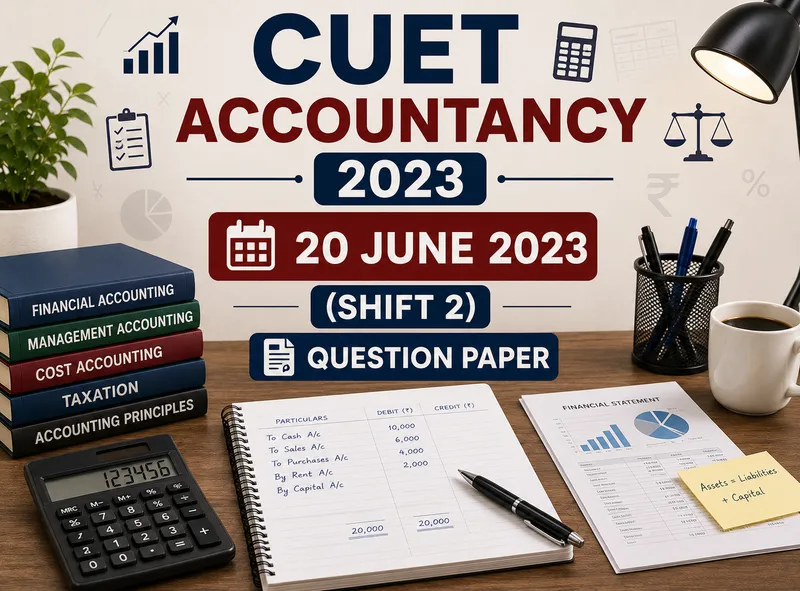
A comprehensive CUET Accountancy Question Paper – 20 June 2023 (Shift 2) designed to help students practice and analyze previous year exam patterns for effective CUET preparation. This paper covers important topics including Accounting for Partnership Firms, Company Accounts, Financial Statements Analysis, Cash Flow Statements, Accounting Ratios, and Fundamental Accounting Principles. It features a balanced mix of conceptual, numerical, and application-based questions to strengthen accounting concepts, improve calculation accuracy, and enhance problem-solving skills. Based on the CUET exam structure and syllabus, this paper is ideal for practice, revision, self-assessment, time management, previous year analysis, and final preparation for upcoming CUET Accountancy examinations.
Copyright © 2026 Combe Labs Private Limited. All Rights Reserved.