The major product of the following chemical reaction is :

Options
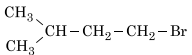
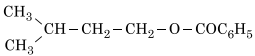
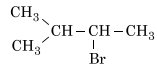
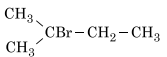
Correct Answer :
Solution :
Correct Answer: 1-bromo-3-methylbutane, representing the structure:
(CH3)2CH - CH2 - CH2 - Br
Explanation:
The reaction involves the addition of hydrogen bromide (HBr) to 3-methylbut-1-ene in the presence of benzoyl peroxide, .
1. Peroxide Effect (Kharasch Effect):
When HBr reacts with an unsymmetrical alkene in the presence of an organic peroxide, the reaction proceeds via a free-radical mechanism rather than an electrophilic addition. This results in the anti-Markovnikov addition of HBr across the double bond.
2. Reaction Mechanism:
The mechanism consists of three main steps: initiation, propagation, and termination.
Step I: Chain Initiation
Benzoyl peroxide undergoes homolysis to form benzoyloxy radicals, which then decarboxylate to produce phenyl radicals:
The phenyl radical abstracts a hydrogen atom from HBr to generate a bromine radical ():
Step II: Chain Propagation
The bromine radical attacks the double bond of 3-methylbut-1-ene. There are two potential carbon atoms to attack:
• If attacks the terminal carbon (C1), it forms a secondary carbon radical, which is relatively stable:
(More Stable Secondary Radical)
• If attacks the inner double-bonded carbon (C2), it forms a primary carbon radical, which is less stable:
(Less Stable Primary Radical)
The reaction selectively proceeds via the more stable secondary free radical intermediate. Unlike carbocations, these free radical intermediates do not undergo rearrangement under standard addition conditions.
In the next propagation step, the secondary carbon radical abstracts a hydrogen atom from another HBr molecule to yield the final product and regenerate a bromine radical:
Conclusion:
The major product obtained is the anti-Markovnikov addition product, 1-bromo-3-methylbutane, which corresponds to the structure shown in Image 1:
(CH3)2CH - CH2 - CH2 - Br
Access expert-curated educational resources and study materials—completely free.
Create, conduct, and manage professional online assessments with Mindyard. Perfect for teachers and institutes.
Copyright © 2026 Mindyard. All Rights Reserved.