
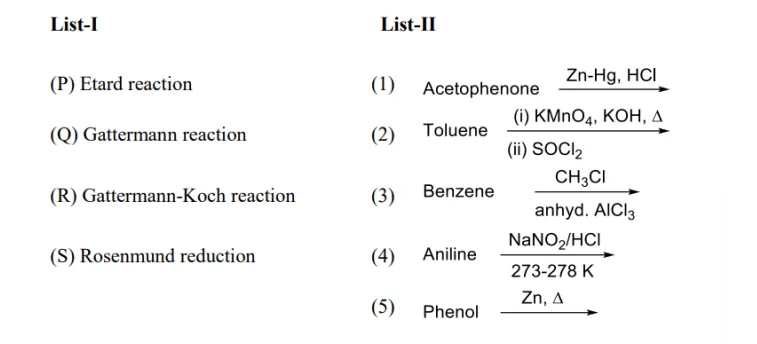
The major products obtained from the reactions in List-II are the reactants for the named reactions mentioned in List-I. Match List-I with List-II and choose the correct option.
Solution :
The correct option is P → 3; Q → 4; R → 5; S → 2.
To match List-I (named reactions) with List-II (reactions yielding major products that serve as starting reactants), let us analyze the products formed in each reaction of List-II from the provided image:
Analysis of Reactions in List-II:
1. Acetophenone + Zn-Hg/HCl (Clemmensen Reduction):
Acetophenone (C6H5COCH3) undergoes reduction to form ethylbenzene (C6H5CH2CH3).
2. Toluene + (i) KMnO4, KOH, Δ (ii) SOCl2:
First, oxidation of toluene yields benzoic acid (C6H5COOH). Subsequent treatment with thionyl chloride (SOCl2) converts benzoic acid into benzoyl chloride (C6H5COCl).
Benzoyl chloride (C6H5COCl) is the starting reactant for the Rosenmund reduction (S → 2).
3. Benzene + CH3Cl / anhyd. AlCl3 (Friedel-Crafts Alkylation):
Reaction of benzene with methyl chloride in the presence of anhydrous AlCl3 forms toluene (C6H5CH3).
Toluene is the starting reactant for the Etard reaction, which oxidizes toluene to benzaldehyde using chromyl chloride (P → 3).
4. Aniline + NaNO2 / HCl at 273-278 K (Diazotization):
Diazotization of aniline yields benzene diazonium chloride (C6H5N2+Cl-).
Benzene diazonium chloride reacts with Cu/HCl or Cu/HBr to form haloarenes, which is known as the Gattermann reaction (Q → 4).
5. Phenol + Zn, Δ (Reduction):
Heating phenol with zinc dust yields benzene (C6H5).
Benzene is treated with CO and HCl in the presence of anhydrous AlCl3/CuCl to form benzaldehyde, which is known as the Gattermann-Koch reaction (R → 5).
Summary of Matching:
(P) Etard reaction → (3) Toluene (obtained from Benzene + CH3Cl / anhyd. AlCl3)
(Q) Gattermann reaction → (4) Benzene diazonium chloride (obtained from Aniline + NaNO2/HCl)
(R) Gattermann-Koch reaction → (5) Benzene (obtained from Phenol + Zn, Δ)
(S) Rosenmund reduction → (2) Benzoyl chloride (obtained from Toluene + KMnO4 then SOCl2)
Thus, the correct matching combination is P → 3; Q → 4; R → 5; S → 2.
Completely free for students. Educators & coaching institutes get 2 months free Pro trial to create tests.
Access unlimited practice questions, detailed step-by-step solutions, and exam study materials — completely free for students.
Create and conduct professional online assessments with AI question generation, tab proctoring, and comprehensive batch management.

A comprehensive JEE Advanced 2022 Paper 1 designed to help aspirants understand the examination pattern, difficulty level, and question trends of JEE Advanced. This paper covers important concepts from Physics, Chemistry, and Mathematics, featuring a balanced mix of conceptual, numerical, and advanced application-based questions. It helps students strengthen conceptual understanding, enhance analytical and problem-solving skills, and improve speed and accuracy. Ideal for practice, revision, self-assessment, previous year trend analysis, concept reinforcement, and time management, this paper is a valuable resource for effective JEE Advanced preparation.

A comprehensive JEE Advanced 2022 Paper 2 designed to help aspirants understand the examination pattern, difficulty level, and question trends of JEE Advanced. This paper covers important concepts from Physics, Chemistry, and Mathematics, featuring a balanced mix of conceptual, numerical, and advanced application-based questions. It helps students strengthen conceptual understanding, enhance analytical and problem-solving skills, and improve speed and accuracy. Ideal for practice, revision, self-assessment, previous year trend analysis, concept reinforcement, and time management, this paper is a valuable resource for effective JEE Advanced preparation.
Copyright © 2026 Combe Labs Private Limited. All Rights Reserved.


