The pie given below shows the total population in five cities (A, B, C, D, E).
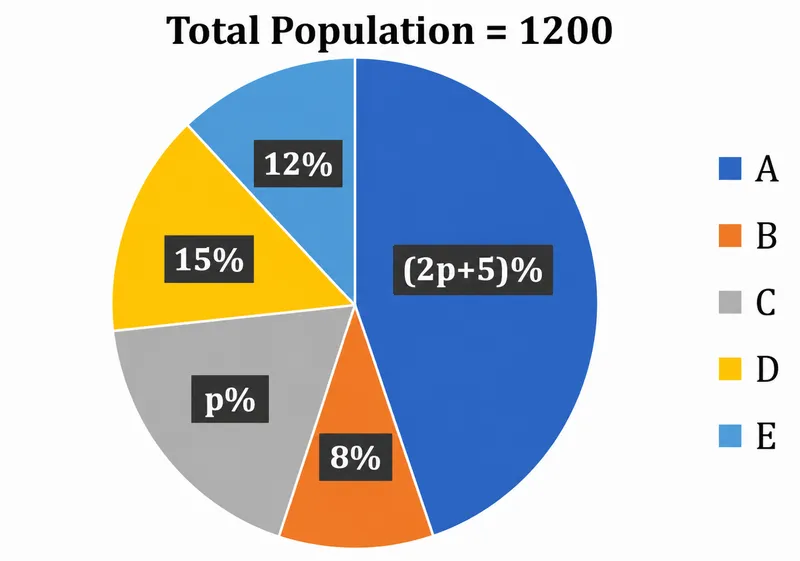
The population of cities D and E is what percentage more/less than the total population of A and C
Correct Answer :
58.46%
Solution :
The correct option is 58.46%.

From the given pie chart showing the population distribution across five cities A, B, C, D, and E:
• Total Population = 1200
• City A =
• City B = 8%
• City C =
• City D = 15%
• City E = 12%
Step 1: Determine the value of
Since the total percentage in a pie chart must equal 100%:
Step 2: Calculate the percentage share of each city
• City A =
• City C =
• City D =
• City E =
Step 3: Calculate combined percentages for (D + E) and (A + C)
Step 4: Find the required percentage less
Difference in percentages:
Percentage by which population of D and E is less than that of A and C:
Therefore, the population of cities D and E is 58.46% less than the total population of cities A and C.
Access expert-curated educational resources and study materials—completely free.
Create, conduct, and manage professional online assessments with Mindyard. Perfect for teachers and institutes.
Copyright © 2026 Mindyard. All Rights Reserved.