The pie given below shows the total population in five cities (A, B, C, D, E).
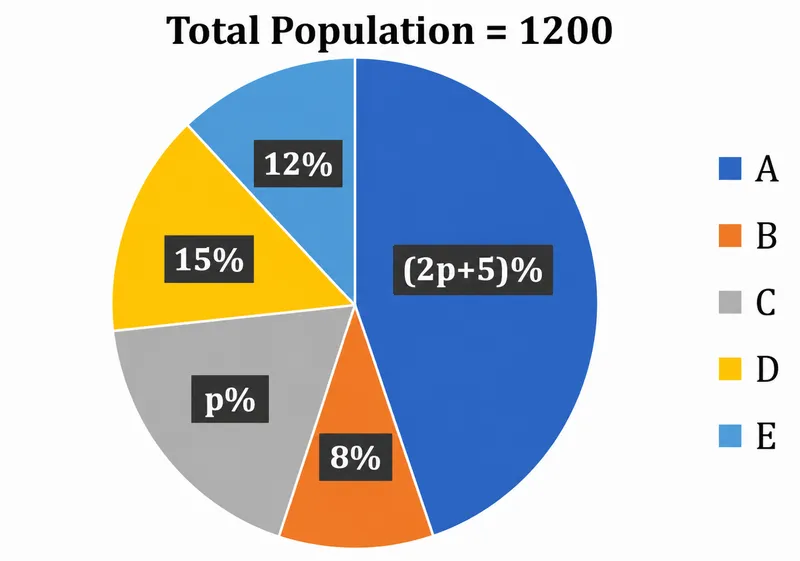
Find the difference between sum of total population of B and C and total population of E?
Correct Answer :
192
Solution :
The correct answer is 192.
First, let's analyze the given pie chart which represents the distribution of the total population of 1200 across five cities (A, B, C, D, and E):
Since the total percentage of all sectors in a pie chart must equal 100%, we can set up the following equation to find the value of :
Simplifying the left-hand side:
Subtracting 40 from both sides:
Dividing by 3:
Now we can write down the percentages for the cities involved in our calculation:
The sum of the percentages of population in B and C is:
The population of city E is represented by 12%.
Next, we calculate the difference in percentage between the sum of B and C and the population of E:
Finally, we find the actual population difference using the total population of 1200:
Access expert-curated educational resources and study materials—completely free.
Create, conduct, and manage professional online assessments with Mindyard. Perfect for teachers and institutes.
Copyright © 2026 Mindyard. All Rights Reserved.