
The pie given below shows the total population in five cities (A, B, C, D, E).
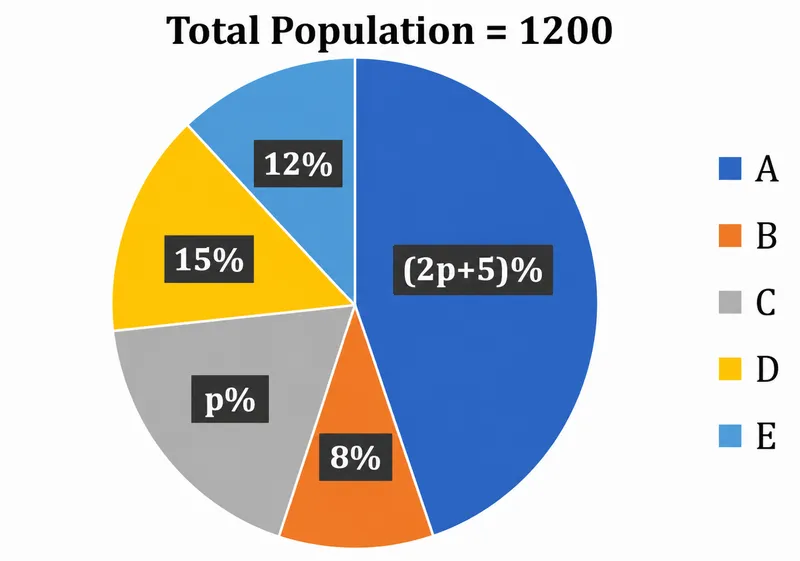
Find the difference between sum of total population of B and C and total population of E?
Correct Answer :
192
Solution :
The correct answer is 192.
Step 1: Analyze the given pie chart data.
From the provided pie chart image showing the population distribution across five cities (A, B, C, D, E):

We are given:
The percentage share for each city is as follows:
Step 2: Calculate the value of .
The sum of all percentage sectors in a pie chart equals 100%:
Combining the terms:
Step 3: Determine the percentages for cities B, C, and E.
Substituting :
Sum of percentages of City B and City C:
Step 4: Compute the difference in population between (B + C) and E.
Difference in percentage:
Calculating 16% of the total population (1200):
Hence, the difference between the sum of the total population of B and C and the total population of E is 192.
Access expert-curated educational resources and study materials—completely free.
Create, conduct, and manage professional online assessments with Mindyard. Perfect for teachers and institutes.
Copyright © 2026 Mindyard. All Rights Reserved.




