The reaction sequence given below is carried out with 16 moles of X. The yield of the major product in each step is given below the product in parentheses. The amount (in grams) of S produced is______.
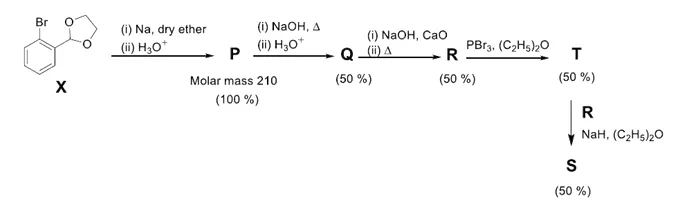
Use: Atomic mass (in amu): H = 1, C = 12, O = 16, Br = 80
Correct Answer :
Solution :
To find the amount of product S produced, we analyze the reaction sequence step-by-step starting with 16 moles of compound X.
Step 1: Synthesis of P
Compound X is 2-(2-bromophenyl)-1,3-dioxolane. When treated with sodium () in dry ether, it undergoes a Wurtz-Fittig homocoupling reaction at the aryl carbon-bromine bond to form a biphenyl dimer with two acetal protecting groups. Subsequent acidic hydrolysis () deprotects both acetal groups to aldehyde groups, yielding biphenyl-2,2'-dicarbaldehyde (P).
The molecular formula of P is .
Molar mass of P = (which matches the molar mass specified in the reaction scheme).
Since 2 moles of X react to produce 1 mole of P at a 100% yield:
Step 2: Synthesis of Q
Biphenyl-2,2'-dicarbaldehyde (P) is treated with and heat, followed by acidic workup. Since it contains two aldehyde groups without any -hydrogens, it undergoes an intramolecular Cannizzaro reaction. One aldehyde group is oxidized to a carboxylic acid and the other is reduced to a primary alcohol, yielding 2'-(hydroxymethyl)biphenyl-2-carboxylic acid (Q).
The yield for this step is 50%:
Step 3: Synthesis of R
Compound Q is subjected to soda-lime decarboxylation () followed by heating. This removes the carboxyl group from the molecule, producing biphenyl-2-ylmethanol (R).
The yield for this step is 50%:
Step 4: Synthesis of T
Alcohol R is treated with phosphorus tribromide () in ether to convert the alcohol group into an alkyl bromide, yielding 2-(bromomethyl)biphenyl (T).
The yield of T is 50%:
This consumes 1 mole of R, leaving of unreacted R.
Step 5: Synthesis of S
The alkyl bromide T and the remaining unreacted alcohol R react in the presence of sodium hydride () in ether via a Williamson ether synthesis to yield the ether product, bis(biphenyl-2-ylmethyl) ether (S).
The chemical formula of S is .
Molar mass of S = .
Since 1 mole of T reacts with 1 mole of R to form 1 mole of S, and the step yield is 50%:
The mass of S produced is:
Therefore, the correct answer is 175.
Access expert-curated educational resources and study materials—completely free.
Create, conduct, and manage professional online assessments with Mindyard. Perfect for teachers and institutes.
Copyright © 2026 Mindyard. All Rights Reserved.