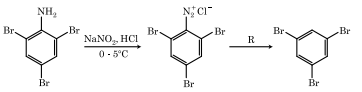
The reagent ‘R’ in the given sequence of chemical reaction is :
Correct Answer :
CH₃CH₂OH
Solution :
The correct option is CH₃CH₂OH.
Step-by-Step Explanation:
1. Diazotization (First Step):
The reactant shown on the far left of the image is 2,4,6-tribromoaniline. When treated with sodium nitrite (NaNO2) and hydrochloric acid (HCl) at a low temperature range of 0 - 5 °C, the amino group (-NH2) undergoes diazotization to form 2,4,6-tribromobenzenediazonium chloride, as shown in the middle structure of the reaction sequence.
2. Reductive Deamination (Second Step):
In the second step of the reaction, the diazonium group (-N2+Cl-) is replaced by a hydrogen atom (-H) to yield 1,3,5-tribromobenzene (shown on the far right). This reduction process is known as deamination.
3. Role of Reagent 'R':
To replace the diazonium group with a hydrogen atom, mild reducing agents are used. Common reagents for this transformation are hypophosphorous acid (H3PO2) or ethanol (CH3CH2OH).
When ethanol (CH3CH2OH) is used, it reduces the diazonium salt to the corresponding arene, while itself getting oxidized to ethanal (acetaldehyde, CH3CHO).
The overall reduction reaction equation is:
Here, the symbol Ar represents the 2,4,6-tribromophenyl group.
4. Analysis of other options:
- H₂O: Hot water converts diazonium salts to phenols.
- HI: Replaces the diazonium group with iodine (-I).
- CuCN/KCN: Replaces the diazonium group with a cyano group (-CN) via the Sandmeyer reaction.
Therefore, the reagent 'R' must be ethanol, CH₃CH₂OH.
Access expert-curated educational resources and study materials—completely free.
Create, conduct, and manage professional online assessments with Mindyard. Perfect for teachers and institutes.
Copyright © 2026 Mindyard. All Rights Reserved.