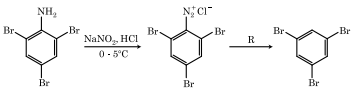
The reagent ‘R’ in the given sequence of chemical reaction is :
Correct Answer :
CH₃CH₂OH
Solution :
The correct answer is CH₃CH₂OH.
Let us break down the reaction sequence step-by-step to understand the role of each chemical and reagent involved:
Step 1: Diazotisation
The starting material shown in the image is 2,4,6-tribromoaniline, which has three bromine substituents at the 2, 4, and 6-positions and an amino group () at the 1-position of the benzene ring.
When treated with sodium nitrite () and hydrochloric acid () at , the amino group undergoes diazotisation to form the diazonium salt:
(as indicated by the group in the intermediate structure).
Step 2: Deamination (Reduction of Diazonium Salt)
In the second step, the diazonium group () is replaced by a hydrogen atom () to yield 1,3,5-tribromobenzene. This reduction reaction is known as deamination.
Mild reducing agents are required to carry out this conversion. The two most common reagents used for this purpose are:
1. Ethanol ()
2. Hypophosphorous acid ()
When ethanol () is used, it reduces the diazonium salt to the corresponding arene while ethanol itself is oxidized to ethanal (acetaldehyde). The general reaction is:
Comparing this with the options provided:
• H₂O: Hydrolysis with water replaces the diazonium group with a hydroxyl group (), forming a phenol.
• CH₃CH₂OH: Successfully reduces the diazonium salt to the corresponding hydrocarbon (replacing with ).
• HI: Replaces the diazonium group with an iodine atom ().
• CuCN/KCN: Replaces the diazonium group with a cyano group () via the Sandmeyer reaction.
Thus, the reagent R is CH₃CH₂OH.
Access expert-curated educational resources and study materials—completely free.
Create, conduct, and manage professional online assessments with Mindyard. Perfect for teachers and institutes.
Copyright © 2026 Mindyard. All Rights Reserved.