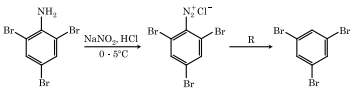
The reagent ‘R’ in the given sequence of chemical reaction is :
Solution :
The correct option is CH₃CH₂OH.
Let us analyze the chemical reaction sequence step-by-step:
Step 1: Diazotization reaction
The starting reactant shown in the image is 2,4,6-tribromoaniline, which features a primary aromatic amino group () on the benzene ring and three bromine () substituents at the 2, 4, and 6 positions.
When treated with sodium nitrite () and hydrochloric acid () at a low temperature of 0 - 5 °C (as written over the first reaction arrow), the amino group undergoes diazotization. This reaction converts the aniline derivative into the corresponding diazonium salt, 2,4,6-tribromobenzenediazonium chloride, which contains the active group as labeled in the second chemical structure.
Step 2: Reduction of Diazonium Salt (Deamination)
In the second step of the sequence, the diazonium group () is replaced by a hydrogen atom () to form 1,3,5-tribromobenzene (the final product shown). This reaction is a reductive deamination.
To reduce the diazonium salt, we need a mild reducing agent that can donate a hydride ion. A classic reagent for this transformation is ethanol ().
During this reaction, ethanol acts as the reducing agent and undergoes oxidation to form acetaldehyde (), while the diazonium ion is reduced to nitrogen gas () along with the formation of hydrochloric acid ().
The general equation for this step is:
(where represents the 2,4,6-tribromophenyl group).
Therefore, the reagent ‘R’ required to carry out this conversion is ethanol, represented by CH₃CH₂OH.
Completely free for students. Educators & coaching institutes get 2 months free Pro trial to create tests.
Access unlimited practice questions, detailed step-by-step solutions, and exam study materials — completely free for students.
Create and conduct professional online assessments with AI question generation, tab proctoring, and comprehensive batch management.

A comprehensive JEE Advanced 2022 Paper 1 designed to help aspirants understand the examination pattern, difficulty level, and question trends of JEE Advanced. This paper covers important concepts from Physics, Chemistry, and Mathematics, featuring a balanced mix of conceptual, numerical, and advanced application-based questions. It helps students strengthen conceptual understanding, enhance analytical and problem-solving skills, and improve speed and accuracy. Ideal for practice, revision, self-assessment, previous year trend analysis, concept reinforcement, and time management, this paper is a valuable resource for effective JEE Advanced preparation.

A comprehensive JEE Advanced 2022 Paper 2 designed to help aspirants understand the examination pattern, difficulty level, and question trends of JEE Advanced. This paper covers important concepts from Physics, Chemistry, and Mathematics, featuring a balanced mix of conceptual, numerical, and advanced application-based questions. It helps students strengthen conceptual understanding, enhance analytical and problem-solving skills, and improve speed and accuracy. Ideal for practice, revision, self-assessment, previous year trend analysis, concept reinforcement, and time management, this paper is a valuable resource for effective JEE Advanced preparation.
Copyright © 2026 Combe Labs Private Limited. All Rights Reserved.