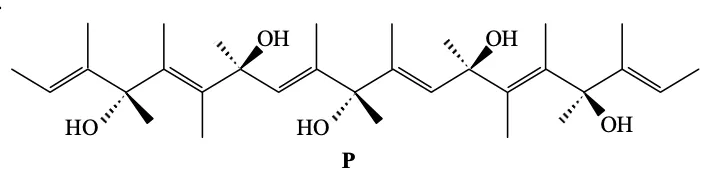
The total number of chiral molecules formed from one molecule of P on complete ozonolysis (O3, Zn/H2O) is _________
Correct Answer :
Solution :
The correct answer is 2.
Step 1: Analyze the structure of molecule P from the given image
By inspecting the provided image of molecule P:
Molecule P has double bonds (alkene units) that undergo reductive ozonolysis with followed by . Reductive ozonolysis cleaves carbon-carbon double bonds () and converts each carbon of the double bond into a carbonyl group ().
Step 2: Cleavage of the double bonds (Ozonolysis reaction)
Let us identify all the double bonds present in molecule P and determine the cleavage products:
1. Terminal double bonds at both ends:
The two outer ends of molecule P feature the group . Upon ozonolysis, the / double bond cleaves to form acetaldehyde (), which is an achiral molecule.
2. Internal fragments with chiral centers:
Cleaving the double bonds around the chiral tertiary alcohol centers gives fragments containing a chiral carbon atom with four distinct groups attached to it:
- An acetyl group ()
- A methyl group ()
- A hydroxyl group ()
- A formyl or acyl/ketone group originating from the adjacent double bond cleavage.
Due to the symmetrical structure of molecule P, the ozonolysis cleavages produce two identical chiral molecules (or chiral units of a specific fragment) per molecule of P.
Step 3: Counting the total number of chiral molecules formed
From one single molecule of P, the complete ozonolysis yields exactly 2 chiral molecules corresponding to the two equivalent chiral fragments formed from the two symmetric halves of the parent structure.
Therefore, the total number of chiral molecules formed from one molecule of P on complete ozonolysis is 2.
Access expert-curated educational resources and study materials—completely free.
Create, conduct, and manage professional online assessments with Mindyard. Perfect for teachers and institutes.
Copyright © 2026 Mindyard. All Rights Reserved.