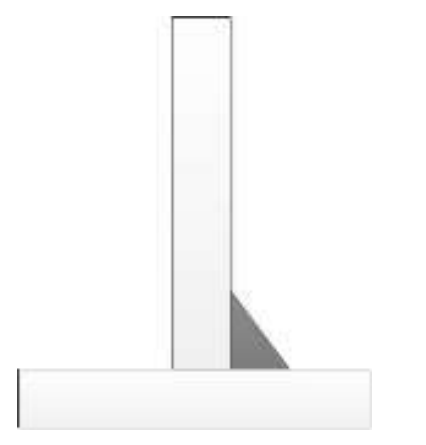
The type of weld represented by the shaded region in the figure is
Solution :
The correct option is fillet.
Understanding Welded Joints and Types of Welds:
Welding is a fabrication process that joins materials, usually metals or thermoplastics, by causing fusion. Different joint designs require specific types of welds. The two most common types are groove welds and fillet welds.
1. Fillet Welds:
A fillet weld joins two surfaces that are approximately perpendicular or meet at an angle (usually 90 degrees). The cross-section of a fillet weld is roughly triangular. They are widely used for joining plates in configurations such as:
• T-joints: Where one plate is perpendicular to another, forming a "T" shape.
• Lap joints: Where two overlapping plates are joined at their edges.
• Corner joints: Where two plates meet at their edges to form an "L" shape.
Analysis of the Provided Images:
• Image 1 (first diagram): Shows a vertical plate placed perpendicularly on top of a horizontal plate, forming a T-joint. The shaded region at the corner junction has a distinct triangular cross-section, which represents a fillet weld.
• Image 2 (reference diagram): Provides several illustrative examples of fillet welds in different configurations. Specifically, it labels "Fillet weld on corner joint" (with a "weld point" indicator), "Fillet weld on lap joint", and "Fillet weld on T-joint". The configuration in Image 1 is a direct match to the single-sided version of the "Fillet weld on T-joint" shown in Image 2.
Why the Other Options are Incorrect:
• Groove: Groove welds are deposited in a prepared channel or groove between two joint members (such as butt joints where plates lie in the same plane).
• Plug: A plug weld is formed by filling a circular hole in one overlapping plate to join it to the member beneath it.
• Spot: A spot weld is a localized weld made at a small contact point, typically using resistance welding, without a continuous triangular bead along a joint corner.
Completely free for students. Educators & coaching institutes get 2 months free Pro trial to create tests.
Access unlimited practice questions, detailed step-by-step solutions, and exam study materials — completely free for students.
Create and conduct professional online assessments with AI question generation, tab proctoring, and comprehensive batch management.
The GATE 2026 Mechanical Engineering (ME) examination scheduled for 14 February 2026 is one of the most important national-level competitive exams for engineering graduates aspiring for higher education and prestigious career opportunities in PSU and research organizations. Conducted annually at the national level, the GATE Mechanical Engineering paper evaluates candidates on core subjects such as Engineering Mechanics, Thermodynamics, Fluid Mechanics, Strength of Materials, Manufacturing Processes, and Machine Design, along with General Aptitude and Engineering Mathematics. This examination is a gateway for admission into M.Tech/Ph.D. programs at IITs, NITs, IISc, and other top institutions, as well as recruitment in major Public Sector Undertakings (PSUs) like ONGC, NTPC, BHEL, IOCL, and more. The GATE ME 2026 paper will test conceptual understanding, analytical thinking, and problem-solving ability, making strong preparation essential for success. Candidates are advised to practice previous year papers, mock tests, and focus on conceptual clarity for high scoring performance. This exam on 14/02/2026 is a crucial opportunity for mechanical engineering aspirants to secure their future in academia and industry.
Strengthen your preparation with this GATE 2025 Mechanical Engineering (ME) test, covering core subjects such as thermodynamics, fluid mechanics, strength of materials, theory of machines, and manufacturing engineering. With a well-balanced mix of conceptual and numerical questions, this test helps enhance problem-solving ability and technical understanding. Aligned with the latest exam pattern, it is ideal for improving accuracy, speed, and overall exam readiness.
Copyright © 2026 Combe Labs Private Limited. All Rights Reserved.