Which of the following can NOT be considered as an element of directing?
Solution :
The correct option is Coordination.
Directing is a core function of management that involves instructing, guiding, mentoring, motivating, and leading employees within an organization to achieve desired goals. It is the process through which managers influence the behavior of subordinates and guide them toward efficient work performance.
To understand why coordination is the correct answer, let us examine the established elements of the directing function:
1. Supervision: The process of overseeing the work of subordinates to ensure that resources are utilized optimally and tasks are performed according to instructions.
2. Motivation: The act of inspiring and encouraging employees to work with zeal and confidence to achieve organizational objectives.
3. Leadership: The process of influencing the behavior and actions of individuals to guide them towards cooperative efforts.
4. Communication: The exchange of information, ideas, views, or feelings between individuals to establish a common understanding.
Why Coordination is NOT an element of directing:
Coordination is not a sub-element of directing; rather, it is widely referred to as the essence of management. Coordination is an overarching function that binds all the other managerial activities (planning, organizing, staffing, directing, and controlling) together. While directing focuses on guiding and motivating subordinates, coordination ensures harmony, integration, and synchronization among different departments, units, and efforts throughout the entire organization.
Completely free for students. Educators & coaching institutes get 2 months free Pro trial to create tests.
Access unlimited practice questions, detailed step-by-step solutions, and exam study materials — completely free for students.
Create and conduct professional online assessments with AI question generation, tab proctoring, and comprehensive batch management.
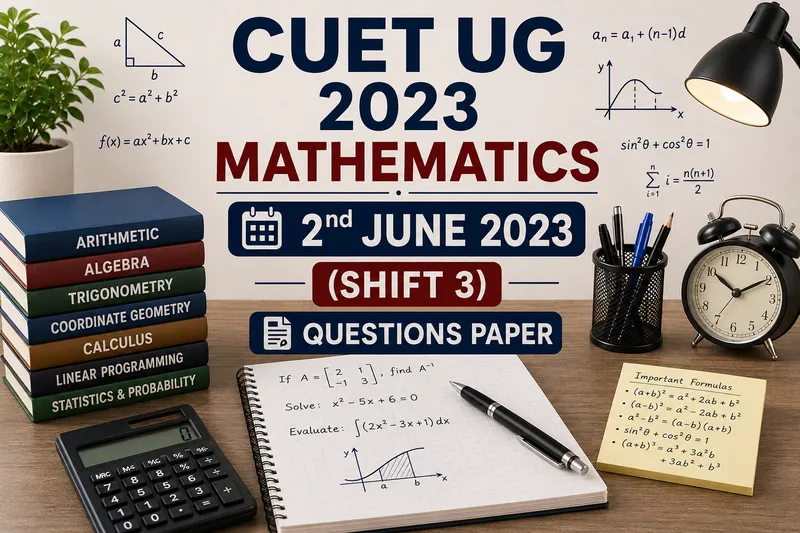
A comprehensive CUET UG Mathematics Question Paper with Solutions – 2 June 2023 (Shift 3) designed to help students practice and understand the actual CUET exam pattern. This paper covers important topics from Algebra, Calculus, Coordinate Geometry, Probability, Statistics, Matrices, Determinants, and Vectors, featuring a balanced mix of conceptual, numerical, and application-based questions. Detailed solutions are provided to strengthen problem-solving skills, improve conceptual clarity, and enhance calculation accuracy. Based on the CUET syllabus and previous year exam trends, this paper is ideal for practice, revision, self-assessment, time management, previous year analysis, and final preparation for upcoming CUET UG Mathematics examinations.
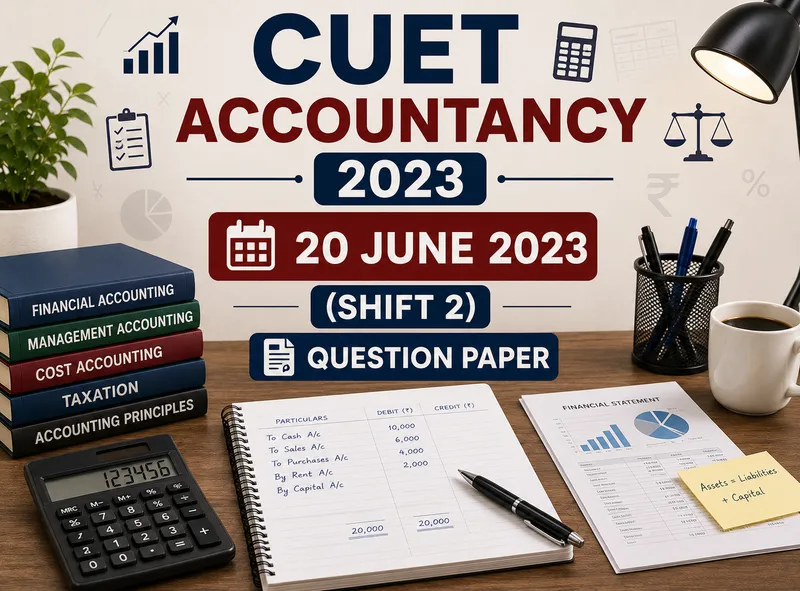
A comprehensive CUET Accountancy Question Paper – 20 June 2023 (Shift 2) designed to help students practice and analyze previous year exam patterns for effective CUET preparation. This paper covers important topics including Accounting for Partnership Firms, Company Accounts, Financial Statements Analysis, Cash Flow Statements, Accounting Ratios, and Fundamental Accounting Principles. It features a balanced mix of conceptual, numerical, and application-based questions to strengthen accounting concepts, improve calculation accuracy, and enhance problem-solving skills. Based on the CUET exam structure and syllabus, this paper is ideal for practice, revision, self-assessment, time management, previous year analysis, and final preparation for upcoming CUET Accountancy examinations.
Copyright © 2026 Combe Labs Private Limited. All Rights Reserved.