Which of the following is incorrect?
Options

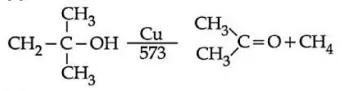


Correct Answer :
Solution :
The correct option (the incorrect reaction) is shown in the second image:
Explanation of why this reaction is incorrect:
When primary or secondary alcohols are passed over heated copper () at , they undergo dehydrogenation (loss of hydrogen) to form aldehydes and ketones, respectively.
However, tertiary alcohols (such as 2-methylpropan-2-ol, or tert-butyl alcohol, shown in the image with methyl groups attached to the central carbon carrying the group) do not have an -hydrogen atom. Since dehydrogenation is not possible, tertiary alcohols undergo dehydration (loss of a water molecule) under these conditions.
Therefore, the reaction of tert-butyl alcohol with heated copper at yields 2-methylpropene (isobutylene) and water, rather than acetone and methane. The correct chemical equation is:
Analysis of the other reactions:
1. First reaction (Image 0): Ethanol () reacts with concentrated at to undergo dehydration, producing ethene () and water. This reaction is correct.
2. Third reaction (Image 2): Propan-2-ol () undergoes dehydration in the presence of to form propene () and water. This reaction is correct.
3. Fourth reaction (Image 3): Ethanol (), a primary alcohol, is dehydrogenated over heated copper at to yield acetaldehyde () and hydrogen gas (). This reaction is correct.
Access expert-curated educational resources and study materials—completely free.
Create, conduct, and manage professional online assessments with Mindyard. Perfect for teachers and institutes.
Copyright © 2026 Mindyard. All Rights Reserved.