
Which of the following is most acidic?
Options
Bu-OH
Solution :
The correct answer is 2,4-dinitrophenol (Option 4).
To determine which compound is the most acidic, we must examine the stability of the conjugate base (anion) formed after the release of a proton (). A more stable conjugate base corresponds to a stronger parent acid. Let us analyze each option:
1. Bu-OH (Butanol): This is an aliphatic alcohol. Its conjugate base is a butoxide ion (). The alkyl group exerts an electron-donating inductive effect (+I effect) that increases the electron density on the oxygen atom, destabilizing the negative charge. Consequently, aliphatic alcohols are weakly acidic (pKa ≈ 16).
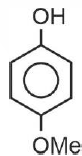
2. 4-Methoxyphenol (Image 0 / Option 2): Phenols are much more acidic than aliphatic alcohols because the negative charge of the phenoxide ion is resonance-stabilized by the benzene ring. However, the methoxy group () at the para-position is electron-donating via resonance (+R effect), which destabilizes the phenoxide ion and reduces acidity compared to unsubstituted phenol (pKa ≈ 10.2).
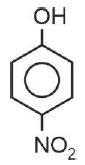
3. 4-Nitrophenol (Image 1 / Option 3): The nitro group () is a strong electron-withdrawing group via resonance (-R effect) and induction (-I effect). Because it is para to the hydroxyl group, it stabilizes the conjugate base by effectively dispersing the negative charge onto the electronegative oxygen atoms of the nitro group (pKa ≈ 7.15).
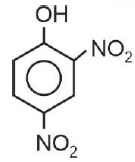
4. 2,4-Dinitrophenol (Image 2 / Option 4): This compound contains two strong electron-withdrawing nitro groups at the ortho (2-) and para (4-) positions. Both groups withdraw electron density through resonance (-R) and induction (-I), providing exceptionally strong stabilization to the conjugate base by dispersing the negative charge across multiple electronegative sites (pKa ≈ 4.1).
Comparing the stability of the conjugate bases, we have:
2,4-dinitrophenoxide ion > 4-nitrophenoxide ion > 4-methoxyphenoxide ion > butoxide ion
Thus, 2,4-dinitrophenol is the most acidic compound.
Completely free for students. Educators & coaching institutes get 2 months free Pro trial to create tests.
Access unlimited practice questions, detailed step-by-step solutions, and exam study materials — completely free for students.
Create and conduct professional online assessments with AI question generation, tab proctoring, and comprehensive batch management.

A comprehensive JEE Advanced 2022 Paper 1 designed to help aspirants understand the examination pattern, difficulty level, and question trends of JEE Advanced. This paper covers important concepts from Physics, Chemistry, and Mathematics, featuring a balanced mix of conceptual, numerical, and advanced application-based questions. It helps students strengthen conceptual understanding, enhance analytical and problem-solving skills, and improve speed and accuracy. Ideal for practice, revision, self-assessment, previous year trend analysis, concept reinforcement, and time management, this paper is a valuable resource for effective JEE Advanced preparation.

A comprehensive JEE Advanced 2022 Paper 2 designed to help aspirants understand the examination pattern, difficulty level, and question trends of JEE Advanced. This paper covers important concepts from Physics, Chemistry, and Mathematics, featuring a balanced mix of conceptual, numerical, and advanced application-based questions. It helps students strengthen conceptual understanding, enhance analytical and problem-solving skills, and improve speed and accuracy. Ideal for practice, revision, self-assessment, previous year trend analysis, concept reinforcement, and time management, this paper is a valuable resource for effective JEE Advanced preparation.
Copyright © 2026 Combe Labs Private Limited. All Rights Reserved.


