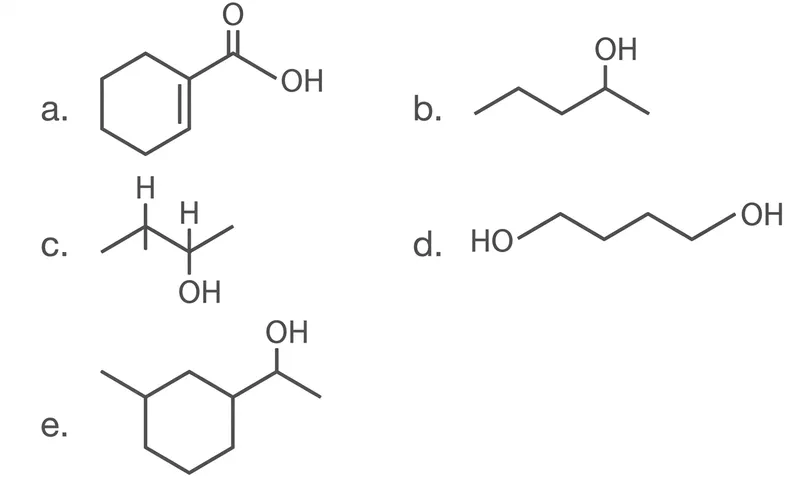
Which of the following molecules is secondary alcohol?
Correct Answer :
b, c, e only
Solution :
The correct answer is b, c, e only.
To determine which of the given molecules are secondary (2°) alcohols, we must first understand the definition of a secondary alcohol. An alcohol is classified as secondary when the hydroxyl group (–OH) is attached to a carbon atom that is directly bonded to exactly two other carbon atoms.
Let us analyze each structure shown in the image:
• Molecule a: This structure contains a carboxylic acid functional group (–COOH) attached to a cyclohexene ring. It is a carboxylic acid (cyclohex-1-ene-1-carboxylic acid), not an alcohol.
• Molecule b: This is pentan-2-ol. The –OH group is attached to a carbon atom that is bonded to two other carbon atoms (a methyl group on one side and a propyl group on the other). Therefore, it is a secondary alcohol.
• Molecule c: This is butan-2-ol. The –OH group is attached to a carbon atom that is bonded to two other carbon atoms (a methyl group and an ethyl group). Therefore, it is a secondary alcohol.
• Molecule d: This is butane-1,4-diol. It has two –OH groups, both of which are attached to terminal carbon atoms (each carbon is bonded to only one other carbon atom). Therefore, these are primary (1°) alcohol groups.
• Molecule e: The carbon atom carrying the –OH group is bonded to a methyl group (–CH3) and to a carbon atom of the cyclohexane ring. Since this carbon is bonded to two other carbon atoms, it is a secondary alcohol.
Thus, molecules b, c, and e are secondary alcohols.
Access expert-curated educational resources and study materials—completely free.
Create, conduct, and manage professional online assessments with Mindyard. Perfect for teachers and institutes.
Copyright © 2026 Mindyard. All Rights Reserved.