A farmer had a rectangular land containing 205 trees. He distributed that land among his four daughters – Abha, Bina, Chitra and Dipti by dividing the land into twelve plots along three rows (X,Y,Z) and four Columns (1,2,3,4) as shown in the figure below:
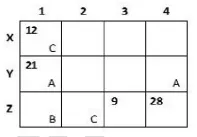
The plots in rows X, Y, Z contained mango, teak and pine trees respectively. Each plot had trees in non-zero multiples of 3 or 4 and none of the plots had the same number of trees. Each daughter got an even number of plots. In the figure, the number mentioned in top left corner of a plot is the number of trees in that plot, while the letter in the bottom right corner is the first letter of the name of the daughter who got that plot (For example, Abha got the plot in row Y and column 1 containing 21 trees). Some information in the figure got erased, but the following is known:
1. Abha got 20 trees more than Chitra but 6 trees less than Dipti.
2. The largest number of trees in a plot was 32, but it was not with Abha.
3. The number of teak trees in Column 3 was double of that in Column 2 but was half of that in Column 4.
4. Both Abha and Bina got a higher number of plots than Dipti.
5. Only Bina, Chitra and Dipti got corner plots.
6. Dipti got two adjoining plots in the same row.
7. Bina was the only one who got a plot in each row and each column.
8. Chitra and Dipti did not get plots which were adjacent to each other (either in row / column / diagonal).
9. The number of mango trees was double the number of teak trees.
Which of the following statements is NOT true?
Solution :
The correct option (the statement that is NOT true) is: "Bina got 32 pine trees."
Let us reconstruct the logical distribution of trees and plots step-by-step:
1. Row and Tree Type Definitions:
- Row X contains Mango trees.
- Row Y contains Teak trees.
- Row Z contains Pine trees.
- The total number of trees is 205.
2. Mathematical Relations and Row Totals:
Let the total number of teak trees be
. Since the number of mango trees is double the number of teak trees, the total number of mango trees is
.
Thus, the sum of mango, teak, and pine trees is:
For the Teak row (Row Y):
- Plot Y1 (Row Y, Column 1) has 21 trees.
- Let the number of teak trees in Column 2 (Plot Y2) be
.
- According to clue 3, the teak trees in Column 3 (Plot Y3) is double that of Column 2 (
) and half of Column 4 (Plot Y4), which makes Column 4 have
trees.
- Therefore, the total teak trees is:
Substituting this back into the total tree equation:
Since each plot contains a non-zero multiple of 3 or 4:
- Setting
yields:
This gives us:
- Total Teak Trees = 49 (with plot values: 21, 4, 8, 16)
- Total Mango Trees = 98
- Total Pine Trees = 58
3. Complete Grid and Daughter Assignment Table:
By matching the remaining clue parameters (adjacency constraints, even plots, corner assignments, and tree counts that are multiples of 3 or 4 up to a maximum of 32), we get the following complete distribution:
| Row (Tree Type) | Column 1 | Column 2 | Column 3 | Column 4 |
|---|---|---|---|---|
| X (Mango) | 12 (Chitra) | 30 (Bina) | 32 (Dipti) | 24 (Dipti) |
| Y (Teak) | 21 (Abha) | 4 (Abha) | 8 (Bina) | 16 (Abha) |
| Z (Pine) | 3 (Bina) | 18 (Chitra) | 9 (Abha) | 28 (Bina) |
4. Summary of Tree Counts for Each Daughter:
- Abha: Y1 (21) + Y2 (4) + Y4 (16) + Z3 (9) = 50 trees (All of her teak trees equal 21 + 4 + 16 = 41 teak trees).
- Bina: X2 (30) + Y3 (8) + Z1 (3) + Z4 (28) = 69 trees.
- Chitra: X1 (12) + Z2 (18) = 30 trees (including 12 mango trees).
- Dipti: X3 (32) + X4 (24) = 56 trees (all of which are mango trees).
5. Evaluation of the Options:
- "Dipti got 56 mango trees": True (Plots X3 and X4: 32 + 24 = 56).
- "Chitra got 12 mango trees": True (Plot X1 = 12).
- "Abha got 41 teak trees": True (Plots Y1, Y2, Y4: 21 + 4 + 16 = 41).
- "Bina got 32 pine trees": False. Bina got plots Z1 (3 pine trees) and Z4 (28 pine trees), totaling 31 pine trees, not 32.
Completely free for students. Educators & coaching institutes get 2 months free Pro trial to create tests.
Access unlimited practice questions, detailed step-by-step solutions, and exam study materials — completely free for students.
Create and conduct professional online assessments with AI question generation, tab proctoring, and comprehensive batch management.

Prepare effectively for CAT 2017 Slot 1 with this complete question paper and detailed solutions. This paper includes all sections—Verbal Ability & Reading Comprehension (VARC), Data Interpretation & Logical Reasoning (DILR), and Quantitative Aptitude (QA)—with step-by-step explanations to help you understand concepts, improve problem-solving speed, and strengthen your exam strategy. Practicing the CAT 2017 Slot 1 paper is an excellent way to experience the actual exam pattern, difficulty level, and question types asked in the Common Admission Test. This resource is ideal for MBA aspirants targeting top IIMs and other leading B-schools.

Prepare for CAT 2017 Slot 2 with the complete question paper and detailed solutions. This paper covers all three sections—Verbal Ability & Reading Comprehension (VARC), Data Interpretation & Logical Reasoning (DILR), and Quantitative Aptitude (QA)—with clear, step-by-step explanations to help you master important concepts and improve your problem-solving speed. Solving the CAT 2017 Slot 2 paper gives you valuable insight into the actual exam pattern, question types, and difficulty level of the Common Admission Test. It is an essential practice resource for MBA aspirants aiming for admission to IIMs and other top B-schools.
Copyright © 2026 Combe Labs Private Limited. All Rights Reserved.