Question Details

Which of the following will not give SN1.

Options

A

CH2 = CH – CH2 – Cl

B

C

CH3 – CH = CH – Cl

D

Show Answer

Correct Answer :

Option C

CH3 – CH = CH – Cl

Solution :

The correct option is CH3 – CH = CH – Cl.

To determine which of the given compounds will not undergo an SN1 (substitution nucleophilic unimolecular) reaction, we must analyze the stability of the carbocation intermediate formed in the first step of the reaction, as well as the strength of the carbon-chlorine (C–Cl) bond.

1. Mechanism of SN1 Reaction:
An SN1 reaction proceeds via the formation of a carbocation intermediate. The rate of the reaction is directly proportional to the stability of this carbocation. If a compound cannot form a stable carbocation or has a very strong C–Cl bond that is difficult to break, it will not undergo an SN1 reaction.

2. Analysis of the Options:
Let us evaluate each option:

  • CH2 = CH – CH2 – Cl (Allyl chloride): Upon ionization, it forms the allyl carbocation:

    CH2=CHCH2+

    This carbocation is highly stabilized by resonance. Therefore, it undergoes the SN1 reaction readily.
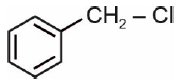
  • Benzyl chloride (shown in the first image, C6H5–CH2–Cl): Upon ionization, it forms the benzyl carbocation:

    C6H5CH2+

    This carbocation is extensively stabilized by delocalization of the positive charge over the aromatic benzene ring (resonance stabilization). Hence, it readily undergoes the SN1 reaction.
  • CH3 – CH = CH – Cl (1-chloroprop-1-ene, a vinylic halide): In this compound, the chlorine atom is directly attached to an sp2-hybridized carbon atom. The lone pair of electrons on the chlorine atom is in conjugation with the double bond:

    CH3CH=CHClCH3CHCH=Cl+

    This resonance resonance-imparts a partial double-bond character to the C–Cl bond, making it extremely strong and difficult to break. Furthermore, the corresponding vinylic carbocation (CH3CH=CH+) is highly unstable because the positive charge resides on an sp2-hybridized carbon, which is highly electronegative. Therefore, this compound will not undergo an SN1 reaction.
  • tert-Butyl chloride (shown in the second image, (CH3)3C–Cl): Upon ionization, it forms a tertiary carbocation:

    (CH3)3C+

    This carbocation is highly stable due to the strong inductive effect (+I) and hyperconjugation from the nine hydrogen atoms of the three methyl groups. Thus, it undergoes the SN1 reaction very easily.

Therefore, CH3 – CH = CH – Cl will not give SN1 reaction.

Unlock Our Free Library

Access expert-curated educational resources and study materials—completely free.

Ask AI Tutor
5 left
Q1 View Question & Options
AI Tutor is solving this question...
Reading question context & options...