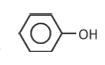
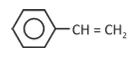
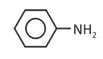
Which one of the following compounds does not decolourize bromine water?
Options
 .
.
 .
.
 .
.
 .
.
Correct Answer :
.
Solution :
The correct answer is cyclohexane (represented by the first image, which shows a simple saturated six-membered ring with no double bonds or activating functional groups).
Here is a detailed, step-by-step scientific explanation of why cyclohexane does not decolorize bromine water, while the other compounds do:
1. Bromine Water Test Overview:
Bromine water is a orange-brown solution of bromine () dissolved in water. It is a classic reagent used in qualitative organic analysis to detect:
• Carbon-carbon double or triple bonds (unsaturation) via electrophilic addition.
• Highly activated aromatic rings (like phenols and amines) via rapid electrophilic aromatic substitution.
When a reaction occurs, bromine is consumed, and the orange-brown color of the solution disappears (decolorization).
2. Analysis of the Options based on the Images:
• Cyclohexane (First Image):
Cyclohexane is a saturated cyclic alkane () containing only single covalent C-C and C-H bonds. Because it lacks any carbon-carbon pi (π) bonds or strongly activating groups, it does not react with bromine water under standard conditions. Thus, it does not decolorize bromine water.
• Phenol (Second Image):
Phenol contains a hydroxyl group (-OH) directly attached to a benzene ring. The lone pair of electrons on the oxygen atom is conjugated with the benzene ring, making it highly activated towards electrophilic aromatic substitution. Phenol reacts rapidly with bromine water even at room temperature to form a white precipitate of 2,4,6-tribromophenol, decolorizing the solution.
• Styrene (Third Image):
Styrene contains a vinyl group (-CH=CH2) conjugated with the benzene ring. The carbon-carbon double bond in the side chain undergoes a rapid electrophilic addition reaction with bromine to form 1,2-dibromoethylbenzene, which is colorless. Therefore, styrene decolorizes bromine water.
• Aniline (Fourth Image):
Aniline contains an amino group (-NH2) directly attached to a benzene ring. Similar to phenol, the lone pair on the nitrogen atom strongly activates the aromatic ring towards electrophilic substitution. Aniline reacts rapidly with bromine water to form a white precipitate of 2,4,6-tribromoaniline, decolorizing the solution.
Access expert-curated educational resources and study materials—completely free.
Create, conduct, and manage professional online assessments with Mindyard. Perfect for teachers and institutes.
Copyright © 2026 Mindyard. All Rights Reserved.