
Which one of the following reactions does NOT give benzene as the product?
Options
Solution :
To determine which reaction does NOT yield benzene as the product, let us analyze each reaction shown in the images step-by-step:
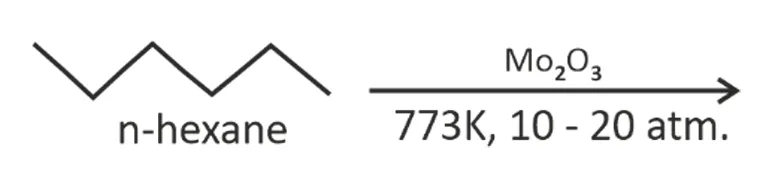
1. Aromatization of n-hexane (Image 1 / Option 1):
When n-hexane is heated at 773 K and 10 - 20 atm pressure in the presence of oxides of molybdenum, vanadium, or chromium (such as shown in the image), it undergoes dehydrogenation and cyclization (aromatization) to form benzene.
The chemical reaction is represented as:
Thus, this reaction produces benzene.
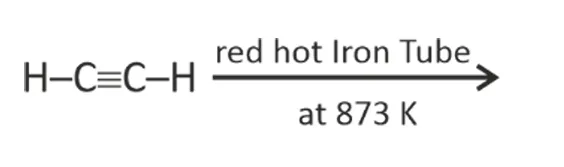
2. Cyclic Polymerization of Ethyne (Image 2 / Option 2):
When ethyne () is passed through a red-hot iron tube at 873 K, three molecules of ethyne undergo cyclic polymerization to yield benzene.
The chemical reaction is represented as:
Thus, this reaction produces benzene.
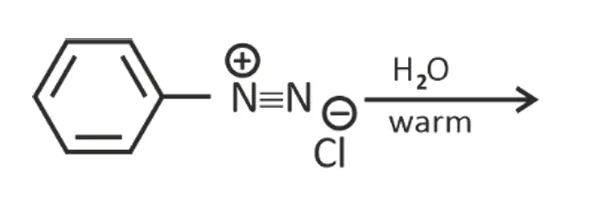
3. Hydrolysis of Benzenediazonium Chloride (Image 3 / Option 3):
When benzenediazonium chloride () is warmed with water (), it undergoes hydrolysis to form phenol () along with the evolution of nitrogen gas and hydrochloric acid.
The chemical reaction is represented as:
Since phenol is the product of this reaction rather than benzene, this reaction does NOT yield benzene.
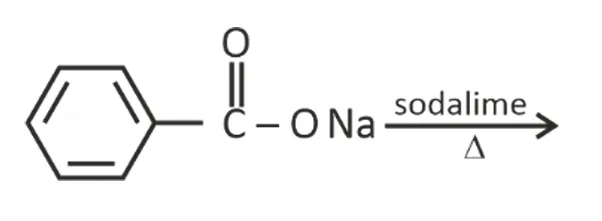
4. Decarboxylation of Sodium Benzoate (Image 4 / Option 4):
Heating sodium benzoate () with sodalime (a mixture of and ) leads to decarboxylation, forming benzene and sodium carbonate ().
The chemical reaction is represented as:
Thus, this reaction produces benzene.
Therefore, the reaction that does NOT give benzene as the product is the warming of benzenediazonium chloride with water (Option 3).
Completely free for students. Educators & coaching institutes get 2 months free Pro trial to create tests.
Access unlimited practice questions, detailed step-by-step solutions, and exam study materials — completely free for students.
Create and conduct professional online assessments with AI question generation, tab proctoring, and comprehensive batch management.

A comprehensive JEE Advanced 2022 Paper 1 designed to help aspirants understand the examination pattern, difficulty level, and question trends of JEE Advanced. This paper covers important concepts from Physics, Chemistry, and Mathematics, featuring a balanced mix of conceptual, numerical, and advanced application-based questions. It helps students strengthen conceptual understanding, enhance analytical and problem-solving skills, and improve speed and accuracy. Ideal for practice, revision, self-assessment, previous year trend analysis, concept reinforcement, and time management, this paper is a valuable resource for effective JEE Advanced preparation.

A comprehensive JEE Advanced 2022 Paper 2 designed to help aspirants understand the examination pattern, difficulty level, and question trends of JEE Advanced. This paper covers important concepts from Physics, Chemistry, and Mathematics, featuring a balanced mix of conceptual, numerical, and advanced application-based questions. It helps students strengthen conceptual understanding, enhance analytical and problem-solving skills, and improve speed and accuracy. Ideal for practice, revision, self-assessment, previous year trend analysis, concept reinforcement, and time management, this paper is a valuable resource for effective JEE Advanced preparation.
Copyright © 2026 Combe Labs Private Limited. All Rights Reserved.


