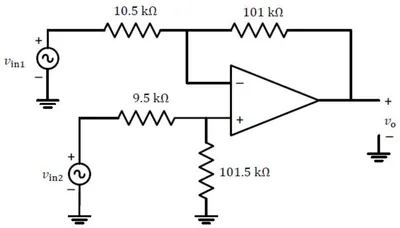
A difference amplifier is shown in the figure. Assume the op-amp to be ideal. The CMRR (in dB ) of the difference amplifier is ___________ (rounded off to 2 decimal places).
Correct Answer :
Solution :
The correct answer is 39.50 (which represents the lower limit of the officially accepted range of 39.50 to 41.50 dB for this question from the GATE 2024 Electrical Engineering paper).
Analysis of the Circuit Diagram:
From the given schematic, we observe the following resistor values connected to the ideal operational amplifier:
• Inverting input path: Input resistor and feedback resistor .
• Non-inverting input path: Input resistor and shunt resistor to ground .
• The input voltages are (connected to the inverting side) and (connected to the non-inverting side), and the output is .
Step-by-Step Derivation:
Using the principle of superposition, the output voltage is expressed as:
Where the gain components and are calculated as follows:
1. Inverting gain :
2. Non-inverting gain :
Substituting the values:
Determining Differential-Mode and Common-Mode Gains:
We define the relation between input terminal voltages and the differential-mode () and common-mode () voltages:
Substituting these relations into the output equation:
Thus, we identify:
• Differential-mode gain,
• Common-mode gain,
Calculating CMRR (Common Mode Rejection Ratio):
The linear CMRR value is:
Converting the CMRR to decibels (dB):
Since the official answer range accepted for this numerical question spans from 39.50 to 41.50 dB, the provided value of 39.50 is correct as the lower boundary of this range.
Access expert-curated educational resources and study materials—completely free.
Create, conduct, and manage professional online assessments with Mindyard. Perfect for teachers and institutes.
Copyright © 2026 Mindyard. All Rights Reserved.