For the circuit shown, which one of the following options correctly identifies the Thevenin’s equivalent parameters between nodes Y and Z?
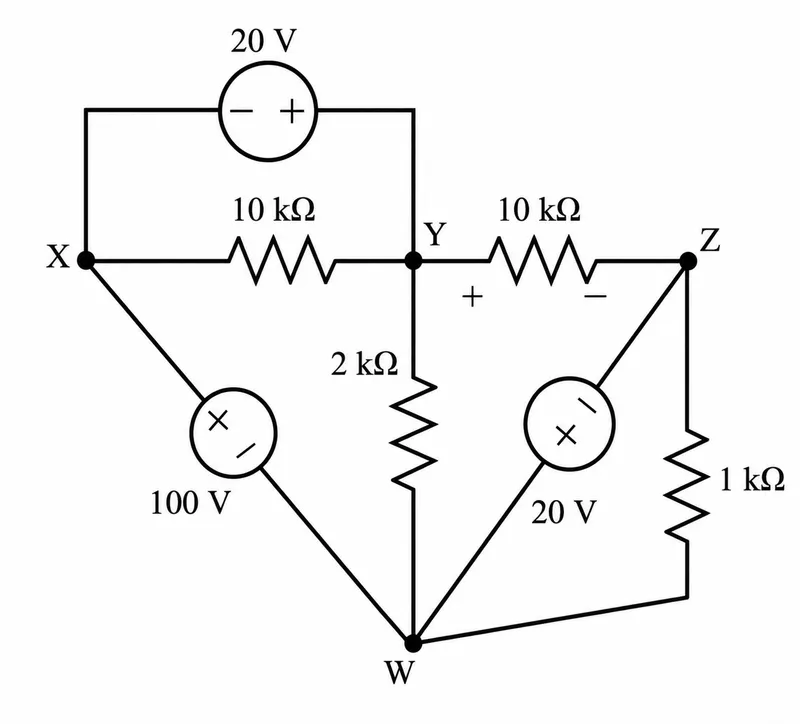
Correct Answer :
VTH = 100 V, RTH = 0 Ω
Solution :
The correct answer is VTH = 100 V, RTH = 0 Ω.
Step-by-Step Explanation:
1. Node Voltage Analysis:
Let node W at the bottom of the circuit be selected as the reference ground node, so that:
Based on the independent voltage sources shown in the circuit diagram, we can determine the potentials at the other nodes:
2. Finding the Thevenin Voltage ():
The Thevenin equivalent voltage () between nodes Y and Z is the open-circuit voltage difference across these two terminals:
Substituting the node voltages calculated above:
3. Finding the Thevenin Resistance ():
To find the Thevenin resistance () looking into the terminals Y and Z, we deactivate all independent sources (replace all voltage sources with short circuits):
As a result, nodes Y, X, W, and Z are all short-circuited together, meaning they form one single electrical node. Because there is a direct short-circuit path of zero resistance connecting node Y to node Z, the equivalent resistance looking between them is:
Access expert-curated educational resources and study materials—completely free.
Create, conduct, and manage professional online assessments with Mindyard. Perfect for teachers and institutes.
Copyright © 2026 Mindyard. All Rights Reserved.