In a single phase transformer, the total iron loss is 2500 W at nominal voltage of 440 V and frequency 50 Hz. The total iron loss is 850 W at 220 V and 25 Hz. Then, at nominal voltage and frequency, the hysteresis loss and eddy current loss respectively are
Solution :
The correct answer is 900 W and 1600 W.
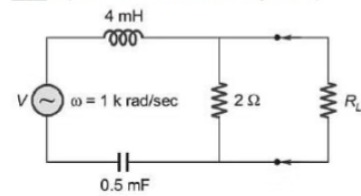
Note on the attached image: The attached image shows a circuit diagram with a voltage source operating at in series with a inductor and capacitor, and a load resistor in parallel with a resistor. This circuit diagram is unrelated to the single-phase transformer problem described in the text. The solution below is derived strictly from the text of the question.
The total iron loss () in a transformer is the sum of the hysteresis loss () and the eddy current loss ():
Let us calculate the ratio of voltage () to frequency () for both cases:
Case 1 (Nominal):
Case 2:
Since the ratio is constant, the maximum flux density () in the core remains constant.
Under constant maximum flux density, the relationships for hysteresis and eddy current losses are:
Hysteresis loss:
Eddy current loss:
where and are constants.
Thus, the total iron loss can be written as:
Dividing both sides by the frequency yields:
Now, substitute the values for the two cases to form a system of linear equations:
For Case 1: at
--- (Equation 1)
For Case 2: at
--- (Equation 2)
Subtract Equation 2 from Equation 1:
Substitute the value of back into Equation 2:
Now, evaluate each loss at the nominal frequency of :
Hysteresis loss:
Eddy current loss:
Completely free for students. Educators & coaching institutes get 2 months free Pro trial to create tests.
Access unlimited practice questions, detailed step-by-step solutions, and exam study materials — completely free for students.
Create and conduct professional online assessments with AI question generation, tab proctoring, and comprehensive batch management.

Prepare for success in the GATE Electrical Engineering exam with our comprehensive Ultimate Revision Test. Designed for aspirants aiming for top scores, this test covers all key topics in the GATE EE syllabus, including Circuit Theory, Electromagnetic Fields, Power Systems, Electrical Machines, Control Systems, and Analog & Digital Electronics. Our revision test offers a balanced mix of theory-based and application-based questions that will help you assess your understanding and boost your problem-solving skills. With carefully selected questions that mirror the difficulty level of the actual GATE exam, this test will help you identify areas for improvement and fine-tune your exam strategy.

Prepare for GATE 2026 Civil Engineering with the latest question papers, previous year papers, detailed solutions, syllabus, exam pattern, preparation tips, mock tests, and subject-wise study material. Download GATE 2026 CE question papers with solutions in PDF format and boost your preparation for top engineering institutes and PSU recruitment.
Copyright © 2026 Combe Labs Private Limited. All Rights Reserved.