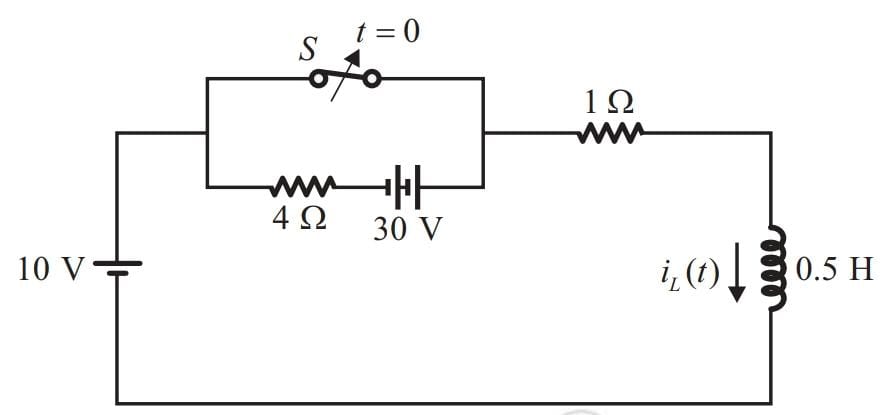
In the circuit, switch ‘S’ is in the closed position for a very long time. If the switch is opened at time t =0, then iL( t) in Amperes, for t ≥0 is
Solution :
To find the inductor current for , we analyze the circuit in two stages: before and after the switch is opened.
1. Initial Condition ():
Before , the switch has been closed for a very long time. Under DC steady-state conditions, the inductor acts as a short circuit.
The closed switch acts as a short circuit across the branch containing the resistor and the source, bypassing them completely.
Thus, the active circuit simply consists of the source connected to the resistor and the short-circuited inductor.
The current through the inductor just before the switch opens is:
Since the current through an inductor cannot change instantaneously, the current immediately after the switch opens is:
2. Final Steady-State Condition ():
At , the switch is opened. The branch containing the resistor and the source is now connected in series with the rest of the loop.
Looking at the polarity of the source, its negative terminal is on the left and its positive terminal is on the right, which series-aids the source.
The total equivalent resistance of the loop is:
The total equivalent DC voltage in the loop is:
As , the circuit reaches a new steady state, and the inductor again acts as a short circuit. The final current is:
3. Time Constant ():
The equivalent resistance in the loop with the switch open is , and the inductance is .
The time constant of this RL circuit is:
The exponential decay factor is:
4. Current Response Equation:
The general transient response equation for a first-order RL circuit is given by:
Substituting the derived values:
Thus, the transient current equation for the inductor is 8 + 2e-10t. Note that the correct option contains a minor typographical rendering error showing as 8 + 2e-0t, which corresponds to 8 + 2e-10t.
Completely free for students. Educators & coaching institutes get 2 months free Pro trial to create tests.
Access unlimited practice questions, detailed step-by-step solutions, and exam study materials — completely free for students.
Create and conduct professional online assessments with AI question generation, tab proctoring, and comprehensive batch management.

Prepare for success in the GATE Electrical Engineering exam with our comprehensive Ultimate Revision Test. Designed for aspirants aiming for top scores, this test covers all key topics in the GATE EE syllabus, including Circuit Theory, Electromagnetic Fields, Power Systems, Electrical Machines, Control Systems, and Analog & Digital Electronics. Our revision test offers a balanced mix of theory-based and application-based questions that will help you assess your understanding and boost your problem-solving skills. With carefully selected questions that mirror the difficulty level of the actual GATE exam, this test will help you identify areas for improvement and fine-tune your exam strategy.

A comprehensive JEE Advanced 2022 Paper 1 designed to help aspirants understand the examination pattern, difficulty level, and question trends of JEE Advanced. This paper covers important concepts from Physics, Chemistry, and Mathematics, featuring a balanced mix of conceptual, numerical, and advanced application-based questions. It helps students strengthen conceptual understanding, enhance analytical and problem-solving skills, and improve speed and accuracy. Ideal for practice, revision, self-assessment, previous year trend analysis, concept reinforcement, and time management, this paper is a valuable resource for effective JEE Advanced preparation.
Copyright © 2026 Combe Labs Private Limited. All Rights Reserved.