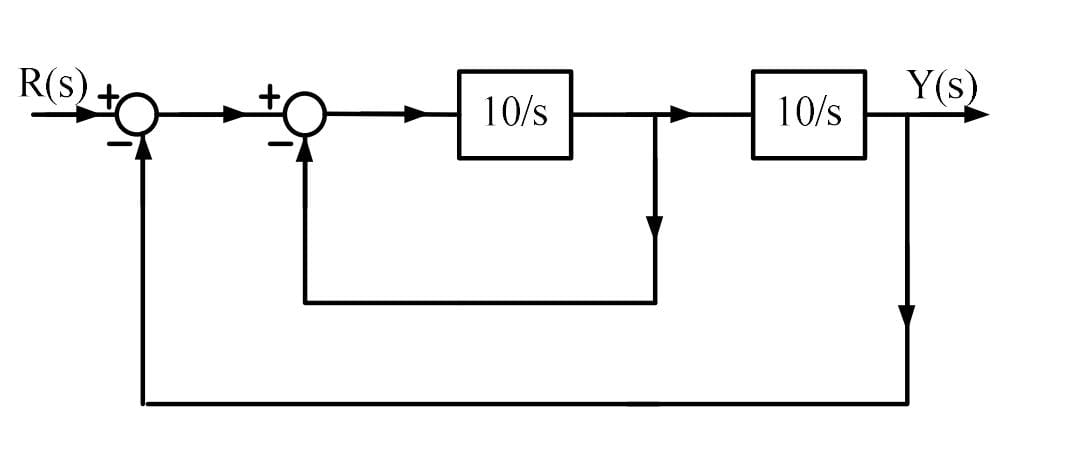
The damping ratio and undamped natural frequency of a closed loop system as shown in the figure, are denoted as ξ and ωn , respectively. The values of ξ and ωn are
Correct Answer :
ξ = 0.5 and ωn=10 rad/s
Solution :
To find the damping ratio () and undamped natural frequency () of the given closed-loop system, we can analyze the block diagram step-by-step:
Step 1: Simplify the inner feedback loop
Let be the output of the first block . The inner feedback loop is a negative feedback loop where the feedback path has a gain of 1 (unity feedback) and the forward path transfer function is:
The closed-loop transfer function of this inner loop, which we can call , is given by:
Step 2: Find the overall open-loop transfer function
The inner loop block is in cascade with the second block . Therefore, the overall forward path transfer function is:
Step 3: Find the overall closed-loop transfer function
The outer feedback loop is also a negative feedback loop with a unity feedback path (). The overall transfer function is:
Step 4: Compare with the standard second-order system equation
The standard transfer function for a second-order system is:
By comparing the denominator terms:
1) For the undamped natural frequency:
2) For the damping ratio:
Substituting into the equation:
Thus, the damping ratio is and the undamped natural frequency is .
Access expert-curated educational resources and study materials—completely free.
Create, conduct, and manage professional online assessments with Mindyard. Perfect for teachers and institutes.
Copyright © 2026 Mindyard. All Rights Reserved.