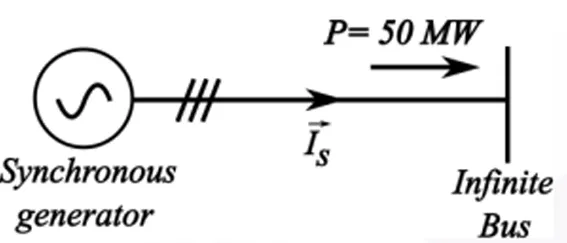
The figure shows the single-line diagram of a synchronous generator delivering P =50 MWof power at unity power factor to an infinite bus. Is denotes the sta tor current phasor. If the field excitation is increased, which one of the following options correctly describes its effect on the stator current, power factor, and load angle of the machine?
Correct Answer :
Stator current increases, power factor becomes lagging, load angle decreases
Solution :
Correct Answer: Stator current increases, power factor becomes lagging, load angle decreases
Detailed Explanation:
The single-line diagram in the figure shows a synchronous generator connected to an infinite bus, delivering a constant active power of
at an initial unity power factor. The stator current is represented by the phasor
.
Since the generator is connected to an infinite bus, the terminal voltage and the frequency remain constant. Additionally, the active power delivered by the generator is kept constant by the turbine/prime mover setting.
Let's analyze the effects of increasing the field excitation step-by-step:
1. Effect on Load Angle (δ):
The active power delivered by a synchronous generator is given by the relation:
Where:
• is the excitation EMF (induced voltage), which is proportional to the field current/excitation.
• is the constant terminal voltage.
• is the synchronous reactance.
• is the load angle (power angle) of the machine.
Since active power , terminal voltage , and reactance are all constant, we have:
When the field excitation is increased, the excitation voltage increases. To keep the product constant, must decrease. Consequently, the load angle decreases.
2. Effect on Power Factor (cos φ):
Initially, the machine operates at unity power factor ().
Increasing the field excitation makes the generator overexcited. An overexcited synchronous generator must supply lagging reactive power to the infinite bus. Therefore, the generator's operating power factor becomes lagging.
3. Effect on Stator Current (Is):
The active power can also be expressed in terms of the stator current and power factor angle :
Since and are constant, we have:
Initially, at unity power factor, is at its maximum value of . When the power factor becomes lagging, decreases ().
For the product to remain constant, the magnitude of the stator current must increase.
(This behavior is also consistent with the V-curve of a synchronous generator, where armature current is minimized at unity power factor and increases as excitation is adjusted away from unity in either direction.)
Thus, as field excitation is increased, the stator current increases, the power factor becomes lagging, and the load angle decreases.
Access expert-curated educational resources and study materials—completely free.
Create, conduct, and manage professional online assessments with Mindyard. Perfect for teachers and institutes.
Copyright © 2026 Mindyard. All Rights Reserved.