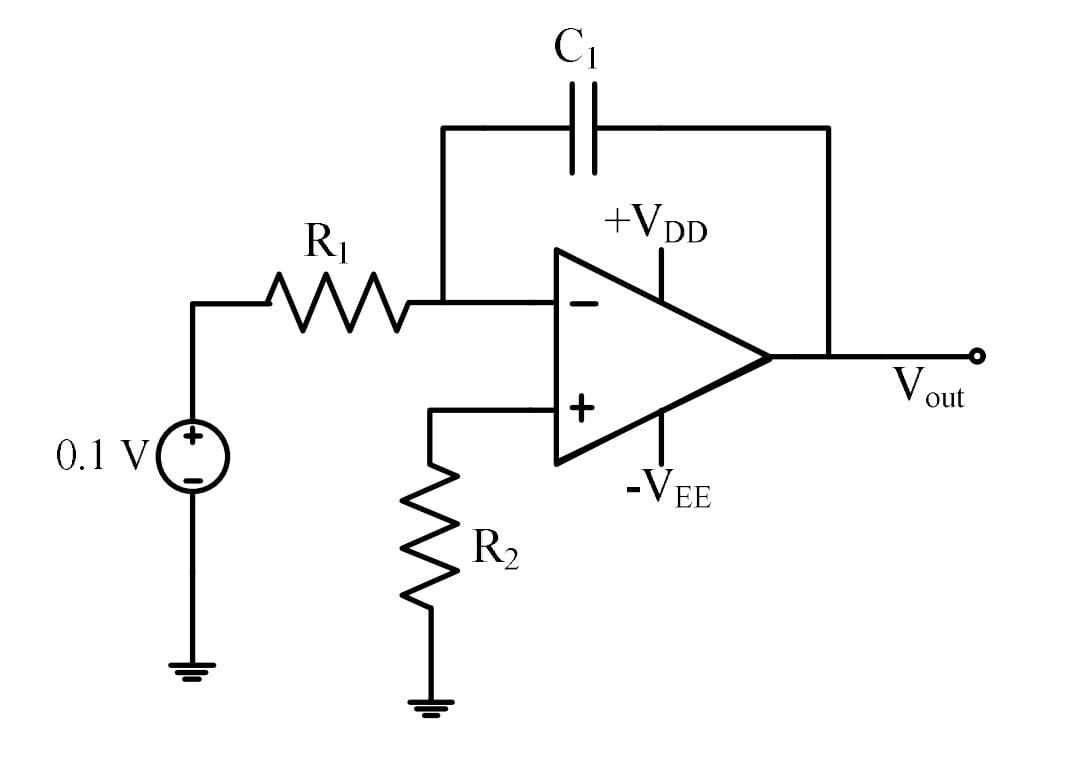
The steady state output (Vout), of the circuit shown below, will
Solution :
The correct answer is: saturate to -VEE
Step-by-Step Explanation:
1. Analyze the Circuit Diagram:
By inspecting the provided circuit diagram, we can identify the following components and connections:
- The circuit is configured as an inverting integrator using an operational amplifier (op-amp).
- A DC voltage source of value is connected to the inverting input terminal (-) via the resistor .
- A feedback capacitor is connected between the inverting input terminal and the output node .
- The non-inverting terminal (+) is connected to ground through a resistor .
- The op-amp is powered by positive and negative bias supply voltages, labeled as and respectively.
2. Apply Op-Amp Analysis Rules:
Assuming an ideal op-amp operating in its active/linear region initially:
- No current enters the input terminals of the ideal op-amp. Consequently, there is no voltage drop across resistor , which sets the voltage at the non-inverting terminal to:
- By the virtual short concept, the voltage at the inverting terminal is equal to the non-inverting terminal:
Therefore, the inverting terminal acts as a virtual ground.
3. Calculate the Input Current:
The current flowing from the DC source through the resistor to the virtual ground is:
Since no current enters the inverting terminal of the op-amp, all of this current must flow through the feedback capacitor towards the output:
4. Determine the Output Voltage Behavior:
The current through the capacitor is given by the relation:
Equating to the constant input current:
Integrating with respect to time gives:
This equation represents a continuously decreasing linear ramp voltage with a negative slope.
5. Steady-State Saturation:
As time approaches infinity (), the output voltage decreases without bound.
However, the output of any practical op-amp is limited by its power supply voltage rails. The negative limit of the output voltage range is defined by the lower supply voltage .
Thus, as the capacitor continues to charge up, the output voltage will eventually hit the negative limit and remain locked at that voltage.
Therefore, in the steady state, the output voltage will saturate to -VEE.
Completely free for students. Educators & coaching institutes get 2 months free Pro trial to create tests.
Access unlimited practice questions, detailed step-by-step solutions, and exam study materials — completely free for students.
Create and conduct professional online assessments with AI question generation, tab proctoring, and comprehensive batch management.

Prepare for success in the GATE Electrical Engineering exam with our comprehensive Ultimate Revision Test. Designed for aspirants aiming for top scores, this test covers all key topics in the GATE EE syllabus, including Circuit Theory, Electromagnetic Fields, Power Systems, Electrical Machines, Control Systems, and Analog & Digital Electronics. Our revision test offers a balanced mix of theory-based and application-based questions that will help you assess your understanding and boost your problem-solving skills. With carefully selected questions that mirror the difficulty level of the actual GATE exam, this test will help you identify areas for improvement and fine-tune your exam strategy.
Prepare effectively for the UPSC Civil Services Examination with the UPSC Prelims 2016 Paper 2 (CSAT) Question Paper with Detailed Solutions. This paper includes all original CSAT questions from the UPSC Prelims 2016 examination along with step-by-step explanations, answer keys, and shortcut techniques.The UPSC CSAT paper tests candidates on Comprehension, Logical Reasoning, Analytical Ability, Decision Making, Basic Numeracy, Data Interpretation, and Mental Ability. Solving previous year question papers is one of the best ways to understand the exam pattern, improve accuracy, and enhance time management skills.
Copyright © 2026 Combe Labs Private Limited. All Rights Reserved.