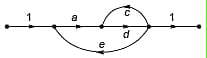
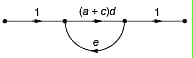
Which of the options is an equivalent representation of the signal flow graph shown here?
Options
 .
.
 .
.
 .
.
 .
.
Correct Answer :
.
Solution :
Correct Answer:
.
Step-by-Step Explanation:
To find the equivalent representation of the given signal flow graph (SFG), let us analyze the node relations and reduce the graph step-by-step.
1. Analyzing the Original Graph:
Let the nodes in the main graph be labeled sequentially from left to right as , , , , and .
From the given image, the branch gains between the nodes are defined as follows:
- Branch from to : gain = 1
- Branch from to : gain = a
- Branch from to : gain = d
- Feedback branch from to : gain = c
- Feedback branch from to : gain = e
- Branch from to : gain = 1
2. Eliminating the Middle Node ():
The signal at node receives inputs from (via gain a) and from (via feedback gain c):
The signal at node is driven by node via gain d:
Substituting the expression for into :
3. Solving for in terms of :
Rearranging the terms containing :
4. Conclusion:
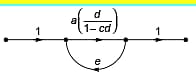
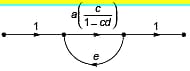
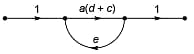
The forward branch gain connecting node directly to node becomes:
While the feedback loop of gain e from node back to node remains unchanged.
Thus, the reduced signal flow graph matches the image in the first option.
Access expert-curated educational resources and study materials—completely free.
Create, conduct, and manage professional online assessments with Mindyard. Perfect for teachers and institutes.
Copyright © 2026 Mindyard. All Rights Reserved.