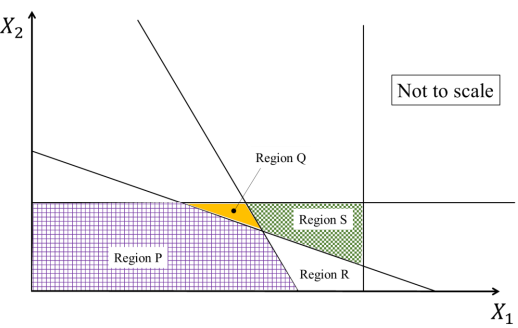
Which one of the options given represents the feasible region of the linear programming model:
Maximize 45X1, + 60X2
X1 ≤ 45
X2 ≤ 50
10X1 + 10X2 ≥ 600
25X1, + 5X2, ≤ 750
Solution :
The correct option is Region Q.
To determine which region represents the feasible region of the given linear programming problem, we analyze the constraints step-by-step:
Constraint 1:
This boundary is a vertical line at
.
The inequality
restricts the feasible region to the left side of this vertical line.
Constraint 2:
This boundary is a horizontal line at
.
The inequality
restricts the feasible region to be below this horizontal line.
Constraint 3:
Dividing both sides by 10 gives:
The boundary line is
with intercepts at
and
.
Testing the origin
:
is False, which means the feasible region lies on the side opposite to the origin (above and to the right of the line).
Constraint 4:
Dividing both sides by 5 simplifies this to:
The boundary line is
with intercepts at
and
.
Testing the origin
:
is True, meaning the feasible region lies on the origin side of this boundary line (below and to the left).
Identifying the Feasible Region:
By combining these constraints, the feasible region is bounded by:
1. Below the horizontal line
2. Above/right of the line
3. Below/left of the line
Let's find the intersection points forming this bounded region:
• Intersection of
and
:
This gives the vertex
.
• Intersection of
and
:
This gives the vertex
.
• Intersection of
and
:
Subtracting the first equation from the second:
Then:
This gives the vertex
.
This forms a triangular region enclosed by the vertices , , and . Comparing this to the provided graph in the image, this exact region is labeled as Region Q.
Completely free for students. Educators & coaching institutes get 2 months free Pro trial to create tests.
Access unlimited practice questions, detailed step-by-step solutions, and exam study materials — completely free for students.
Create and conduct professional online assessments with AI question generation, tab proctoring, and comprehensive batch management.
The CUET General Test Sample Paper 2026 is designed to help aspirants prepare effectively for the General Test section of the Common University Entrance Test (CUET UG). This sample paper provides a comprehensive set of practice questions covering all major topics, including General Knowledge, Current Affairs, Numerical Ability, Logical Reasoning, and Quantitative Aptitude. It follows the latest exam pattern and difficulty level expected in CUET 2026, enabling students to understand question trends, improve time management, and boost accuracy. Each question is carefully curated to reflect real exam scenarios, making it an essential resource for revision and self-assessment. Practicing this sample paper will help candidates identify their strengths and weaknesses, build confidence, and enhance problem-solving skills before the final examination.

Prepare effectively for CAT 2017 Slot 1 with this complete question paper and detailed solutions. This paper includes all sections—Verbal Ability & Reading Comprehension (VARC), Data Interpretation & Logical Reasoning (DILR), and Quantitative Aptitude (QA)—with step-by-step explanations to help you understand concepts, improve problem-solving speed, and strengthen your exam strategy. Practicing the CAT 2017 Slot 1 paper is an excellent way to experience the actual exam pattern, difficulty level, and question types asked in the Common Admission Test. This resource is ideal for MBA aspirants targeting top IIMs and other leading B-schools.
Copyright © 2026 Combe Labs Private Limited. All Rights Reserved.