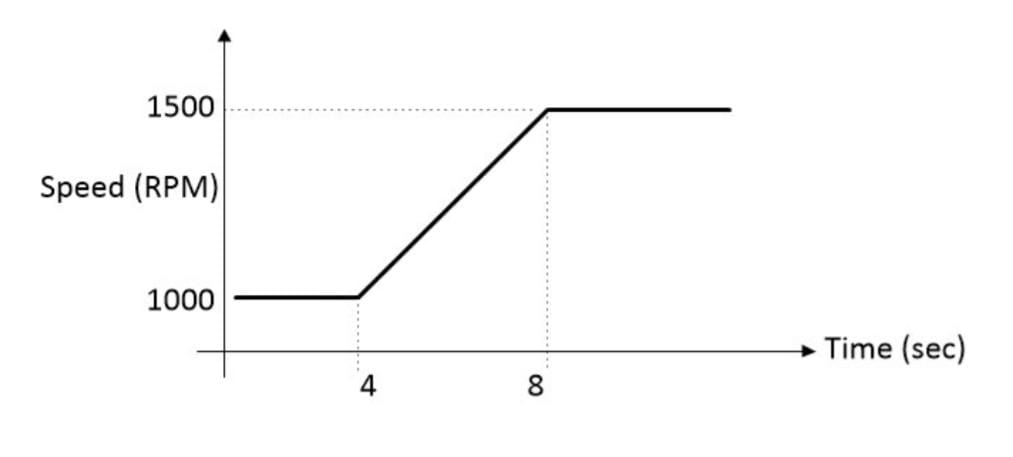
A 4-pole induction motor with inertia of 0.1 kgm2 drives a constant load torque of 2 Nm. The speed of the motor is increased linearly from 1000 rpm to 1500 rpm in 4 seconds as shown in the figure below. Neglect losses in the motor. The energy, in joules, consumed by the motor during the speed change is ______. (round off to nearest integer)
Correct Answer :
Solution :
The correct answer is 1733.
Based on the provided graph, the speed of the 4-pole induction motor increases linearly from 1000 RPM at to 1500 RPM at . This linear change occurs over a duration of 4 seconds ().
1. Equations of Motion and Power
The dynamic equation for the motor-load system is given by:
where:
• is the rotor inertia,
• is the constant load torque,
• is the electromagnetic torque developed by the motor,
• is the angular speed of the motor in rad/s.
Rearranging for electromagnetic torque:
The mechanical power output (neglecting motor losses, which represents the input electrical power) is:
2. Finding Total Energy Consumed
The energy consumed during the speed change is the time integral of the power from to :
Splitting this into kinetic energy change () and energy consumed by the load ():
Step 2a: Calculating Kinetic Energy Change ()
Convert the initial and final speeds from RPM to rad/s:
Now evaluate the kinetic energy term:
Step 2b: Calculating Energy Dissipated by Load Torque ()
Since the speed increases linearly with time, we can determine the average angular speed:
The energy transferred to the load over the 4-second interval is:
Step 2c: Total Energy ()
Adding both energy components:
Rounding to the nearest integer gives 1733 Joules.
Access expert-curated educational resources and study materials—completely free.
Create, conduct, and manage professional online assessments with Mindyard. Perfect for teachers and institutes.
Copyright © 2026 Mindyard. All Rights Reserved.