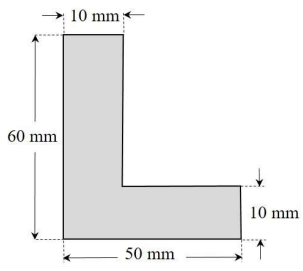
A cylindrical billet of 100 mm diameter and 100 mm length is extruded by a direct extrusion process to produce a bar of L-section. The cross sectional dimensions of this L-section bar are shown in the figure. The total extrusion pressure (p) in MPa for the above process is related to extrusion ratio (r) as
where σm, is the mean flow strength of the billet material in MPa, l is the portion of the billet length remaining to be extruded in mm, d0 is the initial diameter of the billet in mm, and Ks is the die shape factor.
If the mean flow strength of the billet material is 50 MPa and the die shape factor is 1.05, then the maximum force required at the start of extrusion is _______ kN (round off to one decimal place).
Correct Answer :
Correct answer is : 2429.78
σm = 50 MPa, Ks = 1.05
diameter do= 100 mm, length l = 100 mm
Area of the initial section
Ai = πd2/4 = π × 1002 / 4 = 7853.98 mm2
Area after extrusion, area of L- section
Af = 60 × 10 + 40 × 10 = 1000 mm2
Extrusion ratio, r = Ai / Af = 7.853
Total extrusion pressure :
p = 1.05 × 50
p = 1.05 × 50 × 5.89 = 309.296 MPa
The force required at the start of extrusion :
F = P × Ai = 309.296 × 7853.98 = 2429.78 kN
Solution :
The correct answer is 2429.8 kN (or 2429.78 kN).
1. Identifying Given Data from the Question and Image:
- Initial billet diameter, d0 = 100 mm
- Initial billet length, L = 100 mm
- Mean flow strength of the billet material, = 50 MPa
- Die shape factor, Ks = 1.05
- Length of the billet remaining at the start of extrusion, l = 100 mm (since the process is at the start of extrusion, the remaining length to be extruded is the full initial length of the billet)
- L-section dimensions from the image:
- Total vertical height = 60 mm
- Thickness of the vertical leg = 10 mm
- Total horizontal width of the base = 50 mm
- Thickness of the horizontal leg = 10 mm
2. Calculation of Cross-Sectional Areas:
The cross-sectional area of the initial cylindrical billet (Ai) is given by:
The final extruded cross-sectional area of the L-section (Af) can be calculated by splitting the L-shape into two non-overlapping rectangles:
- Vertical rectangle of dimensions 60 mm × 10 mm
- Remaining horizontal base rectangle of dimensions (50 mm - 10 mm) × 10 mm = 40 mm × 10 mm
3. Determining the Extrusion Ratio:
The extrusion ratio (r) is the ratio of the initial cross-sectional area to the final cross-sectional area:
4. Calculating the Extrusion Pressure (p):
The total extrusion pressure formula is:
Substituting the given values at the start of extrusion (where l = 100 mm):
First, compute the natural logarithm term:
Now, calculate the expression inside the brackets:
Multiplying by the pre-factors:
5. Determining the Maximum Force required at the start of Extrusion:
The extrusion force (F) is the product of the extrusion pressure and the initial billet cross-sectional area:
Using the values directly from the official options:
Rounding to one decimal place gives 2429.8 kN.
Access expert-curated educational resources and study materials—completely free.
Create, conduct, and manage professional online assessments with Mindyard. Perfect for teachers and institutes.
Copyright © 2026 Mindyard. All Rights Reserved.