A hollow spherical ball of radius 20 cm floats in still water, with half of its volume submerged. Taking the density of water as 1000 kg/m³, and the acceleration due to gravity as 10 m/s², the natural frequency of small oscillations of the ball, normal to the water surface is _________ radians/s (roundoff to 2 decimal places).
Correct Answer :
Correct answer is : 8.66
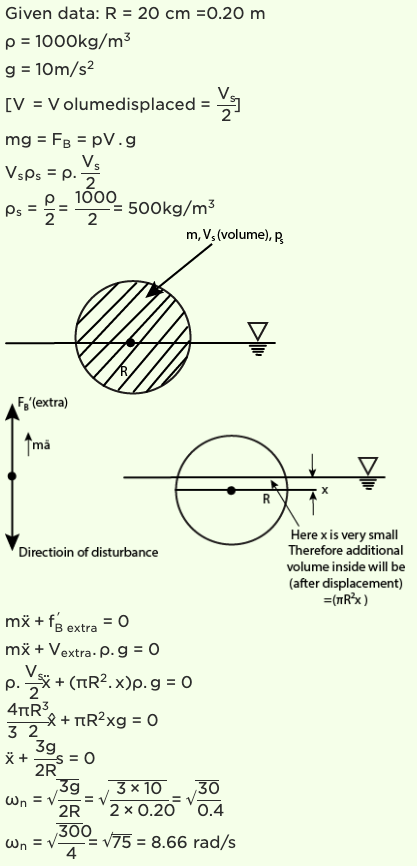
Solution :
The correct answer is 8.66.
Step-by-Step Derivation and Explanation:
1. Determine the Mass of the Floating Ball
Let be the total volume of the hollow spherical ball of radius . The volume of a sphere is given by:
When floating in still water in equilibrium, the buoyant force () balances the weight of the ball ():
where is the density of water and is the submerged volume.
Given that the ball floats with half of its volume submerged, we have:
Thus, we can express the mass of the ball as:
2. Set Up the Equation of Motion for Small Oscillations
When the ball is displaced vertically downward by a small distance from its equilibrium position, it experiences an additional upward buoyant force (restoring force) due to the extra displaced volume of water.
Since the displacement is extremely small, the cross-sectional area of the sphere at the water level remains approximately constant and equal to the cross-sectional area of the sphere at its center:
The additional volume of water displaced is:
The extra buoyant force acting on the ball is:
Using Newton's second law (), the equation of motion is:
which can be rearranged as:
3. Calculate the Natural Frequency
Substitute the expression for obtained in step 1 into the equation of motion:
Dividing by gives:
which simplifies to standard simple harmonic motion form:
The natural frequency is therefore:
Substituting the given values:
- Radius,
- Acceleration due to gravity,
Access expert-curated educational resources and study materials—completely free.
Create, conduct, and manage professional online assessments with Mindyard. Perfect for teachers and institutes.
Copyright © 2026 Mindyard. All Rights Reserved.