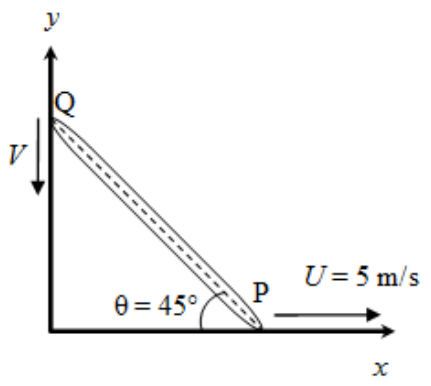
A rigid rod of length 1 m is resting at an angle 45° as shown in the figure. The end P is dragged with a velocity of U = 5 m/s to the right. At the instant shown, the magnitude of the velocity V (in m/s) of point Q as it moves along the wall without losing contact is
Correct Answer :
5
Solution :
Correct Answer: 5
To find the velocity of point Q as it slides down the vertical wall, we can analyze the motion of the rigid rod using two different methods: the coordinate differentiation method and the velocity component projection method.
Method 1: Coordinate Differentiation Method
Let us set up a Cartesian coordinate system as shown in the provided figure, where the vertical wall lies along the y-axis and the horizontal floor lies along the x-axis.
Let the position of point Q on the wall be represented by the coordinate (0, y) and the position of point P on the floor be represented by the coordinate (x, 0).
The length of the rigid rod is constant, given as L = 1 m.
By applying Pythagoras' theorem to the right-angled triangle formed by the wall, the ground, and the rod:
To find the relationship between the velocities, we differentiate both sides with respect to time t:
Simplifying this expression yields:
From the problem description and the image:
- Point P is moving to the right with a velocity U = 5 m/s, so .
- Point Q is moving downwards along the wall, so y is decreasing, meaning (where V is the magnitude of the velocity of Q).
Substituting these rates of change into our differentiated equation:
From the image, the angle between the rod and the horizontal ground is labeled as . Thus:
Since , we have , which means the ratio .
Substituting this ratio back into the velocity equation:
Method 2: Velocity Constraint Along the Rigid Rod
Because the rod is rigid and cannot stretch or compress, the components of the velocities of its endpoints along the direction of the rod's length must be equal.
1. The velocity of point P, , is horizontal to the right. The angle of the rod with the horizontal is . The projection of this velocity along the rod is:
2. The velocity of point Q, V, is vertical downwards. Since the angle of the rod with the horizontal is , the angle it makes with the vertical wall is also . The projection of Q's velocity along the rod is:
Equating the two components along the rod:
Thus, the magnitude of the velocity of point Q is 5 m/s.
Access expert-curated educational resources and study materials—completely free.
Create, conduct, and manage professional online assessments with Mindyard. Perfect for teachers and institutes.
Copyright © 2026 Mindyard. All Rights Reserved.