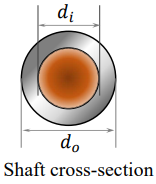
A shaft of length L is made of two materials, one in the inner core and the other in the outer rim, and the two are perfectly joined together (no slip at the interface) along the entire length of the shaft. The diameter of the inner core is d; and the external diameter of the rim is d0, as shown in the figure. The modulus of rigidity of the core and rim materials are Gi and G0, respectively. It is given that d0 = 2di and Gi = 3G0. When the shaft is twisted by application of a torque along the shaft axis, the maximum shear stress developed in the outer rim and the inner core turn out to be τ0 and τi, respectively. All the deformations are in the elastic range and stress-strain relations are linear. Then the ratio τi/τ0 is (round off to 2 decimal places).
Correct Answer :
Correct answer is : 1.5
d0 = 2di , Gi = 3G0 , Li = Lo
τi/τ0 = ?
for parallel shaft θo = θi
=
⇒ Ti /To = 3/15
=
τi/τ0 =
τi/τ0 = 3/2 = 1.5
Solution :
The correct answer is 1.5.
Problem Analysis and Image details:
As shown in the shaft cross-section diagram, the shaft is composite, consisting of two concentric parts:
1. An inner core (shaded orange/brown in the center) with diameter and modulus of rigidity .
2. An outer rim (shaded grey/silver) with external diameter and modulus of rigidity .
The total length of both parts is L. They are perfectly joined together along their interface, meaning there is no relative slip between the core and the rim during torsion.
Given Data:
- Modulus of rigidity relation:
- Diameter relation:
- Maximum shear stress in the inner core:
- Maximum shear stress in the outer rim:
Step-by-Step Derivation:
1. Compatibility Condition
Because the inner core and outer rim are perfectly bonded and share the same length, they twist together by the same angle when a torque is applied. Thus, the angle of twist per unit length is identical for both materials:
2. Relation between Shear Stress and Angle of Twist
From the torsion formula for elastic deformation:
where is the radial distance from the center of the shaft.
3. Maximum Shear Stress in the Inner Core
The maximum shear stress in the solid inner core occurs at its outermost radius, which is at :
4. Maximum Shear Stress in the Outer Rim
The outer rim is a hollow cylinder with inner diameter and outer diameter . The maximum shear stress in the outer rim occurs at its outermost boundary, which is at :
5. Finding the Ratio of Maximum Shear Stresses
Taking the ratio of the two maximum shear stresses:
Substitute the given values and :
Thus, the ratio of the maximum shear stress in the inner core to that in the outer rim is 1.5.
Access expert-curated educational resources and study materials—completely free.
Create, conduct, and manage professional online assessments with Mindyard. Perfect for teachers and institutes.
Copyright © 2026 Mindyard. All Rights Reserved.