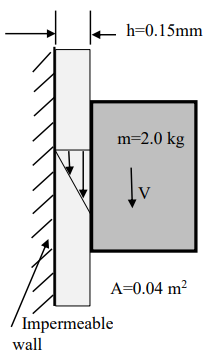
A solid block of 2.0 kg mass slides steadily at a velocity V along a vertical wall as shown in the figure below. A thin oil film of thickness h = 0.15 mm provides lubrication between the block and the wall. The surface area of the face of the block in contact with the oil film is 0.04 m2 . The velocity distribution within the oil film gap is linear as shown in the figure. Take dynamic viscosity of oil as 7×10⁻³ Pa-s and acceleration due to gravity as 10 m/s2 . Neglect weight of the oil. The terminal velocity V (in m/s) of the block is _________ (correct to one decimal place).
Correct Answer :
Solution :
The correct answer is 10.7.
Step-by-step explanation:
First, let us identify the given values from the problem statement and the accompanying schematic diagram:
- Mass of the block,
- Contact area of the block with the oil film,
- Thickness of the oil film,
- Dynamic viscosity of the oil,
- Acceleration due to gravity,
1. Force Balance on the Block:
As the block slides down the wall at a steady terminal velocity , the net acceleration is zero. This means the downward weight of the block is perfectly balanced by the upward viscous shear force exerted by the oil film:
2. Calculation of Weight (Gravity Force):
3. Calculation of Viscous Shear Force:
According to Newton's law of viscosity, the shear stress in the oil film (given a linear velocity distribution) is:
The total viscous drag force acting on the contact surface area is:
4. Determining the Terminal Velocity:
Equating the gravitational force to the viscous force:
Rearranging the equation to solve for the terminal velocity :
Substituting the given values:
Simplify by cancelling out in the numerator and denominator:
Rounding to one decimal place, we obtain:
Access expert-curated educational resources and study materials—completely free.
Create, conduct, and manage professional online assessments with Mindyard. Perfect for teachers and institutes.
Copyright © 2026 Mindyard. All Rights Reserved.