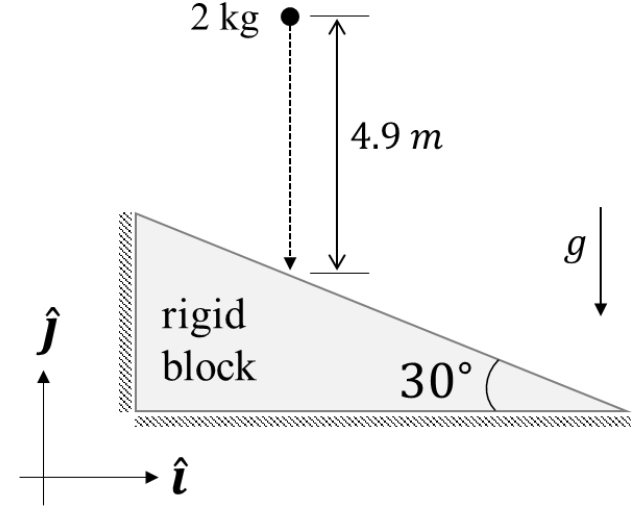
A spherical ball weighing 2 kg is dropped from a height of 4.9 m onto an immovable rigid block as shown in the figure. If the collision is perfectly elastic, what is the momentum vector of the ball (in kg m/s) just after impact?
Take the acceleration due to gravity to be 𝑔 = 9.8 m/s² . Options have been rounded off to one decimal place.
Correct Answer :
17.0 𝒊̂+ 9.8 𝒋̂
Solution :
The correct option is:
17.0 + 9.8
Step 1: Calculate the velocity of the ball just before impact
The ball of mass m = 2 kg is dropped from a height h = 4.9 m. The magnitude of the velocity just before hitting the inclined plane can be determined using the equations of motion under gravity g = 9.8 m/s2:
Substituting the given values:
Since the ball falls vertically downwards in the direction opposite to the unit vector , the velocity vector of the ball just before impact is:
Step 2: Determine the geometry of the inclined surface
From the provided image, the rigid block's inclined surface makes an angle of 30° with the horizontal ( axis).
A unit tangent vector pointing down along the inclined plane is:
The outward unit normal vector perpendicular to this surface (pointing upward and to the right) is:
Step 3: Analyze the elastic collision
Since the collision with the immovable rigid block is perfectly elastic:
1. The component of velocity parallel to the surface (along ) remains unchanged.
2. The component of velocity perpendicular to the surface (along ) is reversed in direction.
The final velocity vector is given by:
First, compute the dot product:
Now, calculate the final velocity vector:
Step 4: Calculate the final momentum vector
The final momentum vector is the mass times the final velocity:
Using the approximation :
Therefore, the final momentum vector of the ball just after impact is:
Access expert-curated educational resources and study materials—completely free.
Create, conduct, and manage professional online assessments with Mindyard. Perfect for teachers and institutes.
Copyright © 2026 Mindyard. All Rights Reserved.