The truss shown in the figure has four members of length l and flexural rigidity EI, and one member of length l√2 and flexural rigidity 4EI. The truss is loaded by a pair of forces of magnitude P, as shown in the figure.
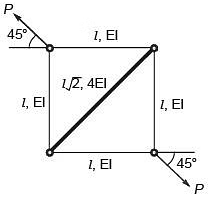
The smallest value of P, at which any of the truss members will buckle is
Correct Answer :
Solution :
The correct answer is:
Step-by-Step Explanation:
1. Analysis of the Truss and External Loading:
As shown in the truss diagram, there are four outer members, each of length l and flexural rigidity EI, forming a square.
A single diagonal member of length l√2 and flexural rigidity 4EI connects the bottom-left joint to the top-right joint.
Two equal and opposite external tensile forces of magnitude P are applied at the top-left and bottom-right joints, oriented at 45° to the horizontal. These forces act along the line connecting the top-left and bottom-right joints, pulling them apart.
2. Determination of Member Forces (Joint Equilibrium):
Let us analyze the forces in the truss members due to the applied loads.
Since the external forces pull the top-left and bottom-right joints apart, the distance between them increases, causing tension in the four outer members.
Let the tension in each of the four outer members be T. By resolving forces at the top-left (or bottom-right) joint:
Now, let us consider the equilibrium of the top-right joint, where the horizontal member (carrying tension T) and the vertical member (carrying tension T) meet the diagonal member (carrying compressive force Fd).
Resolving forces horizontally or vertically at the top-right joint:
Substituting T = P / √2:
Thus, the diagonal member is subjected to a compressive force equal to the external load P, while the outer members are subjected to tensile forces. Since tensile members do not buckle, only the diagonal member is prone to buckling.
3. Calculation of Critical Buckling Load:
The diagonal member is pin-connected at both ends. Its critical Euler buckling load is given by:
For the diagonal member:
- Flexural rigidity, EcIc = 4EI
- Length of the member, Lc = l√2
Substituting these values into the Euler buckling equation:
Therefore, the smallest value of P at which the truss will buckle is:
Access expert-curated educational resources and study materials—completely free.
Create, conduct, and manage professional online assessments with Mindyard. Perfect for teachers and institutes.
Copyright © 2026 Mindyard. All Rights Reserved.